Kozo Okamoto/Ahmed Al-Yabani, PFLP, and the International Solidarity Resistance with Rabab Abdulhadi
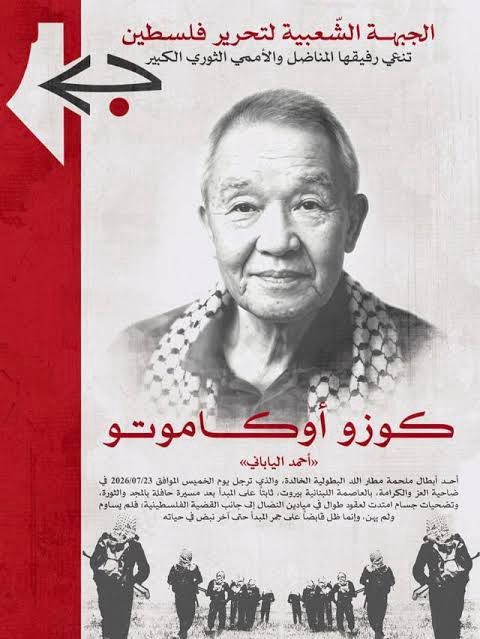
Editorial Note: The following is an edited and abridged transcript of an interview with Dr. Rabab Abdulhadi on The Adnan Husain Show. With gratitude to Adnan Husain.
Adnan Husain (AH): There were these notices that came out last week, July 24th, with the passing of comrade Kozo, comrade Ahmed. People have been reflecting on his remarkable life of resistance. What would you like to say firstly about him, his life, and his passing?
Dr. Rabab Abdulhadi (RA): At the time, I was 17 years old, in my second year of high school. We were under occupation, experiencing all forms of oppression. While we don't have time to discuss everything now, I remember clearly that when we heard about the Lydda operation, our reaction was not different from that of other actions happening outside. We were repressed under military occupation. We simply could not breathe. The occupation was suffocating us and all forms of life. So we heard about it, and then it passed like all other operations—any operations by the fedayeen.
That was the first time I heard about it. As I grew older and became more interested in organizing and the history of resistance, I read more and more, especially about the history of solidarity and internationalism–thinking about why people gravitate from other countries of the world to Palestine, especially given that the younger generation—"Americans" especially—seem to be only interested in the now. They don't like to know about history. They don't ever ask about it. They always think that history began on October 7th in Palestine and don't want to hear about anything else.
This is a reminder that there have been many histories before, details and different ways of understanding. Now people have come to understand Palestine as a signifier of justice. At the time, the Palestine struggle was also a signifier of justice—not everybody knew about it, but definitely people in the Third World, the "Spirit of Bandung" that you and I and many others have been working on before it became vogue. Many people from around the world actually went to Palestine and shared, trained, and worked with the Palestinian resistance movement. People went to the camps in Jordan in particular and joined the Palestinians. The operation that Kozo Okamoto, known as Ahmed Al-Yabani, was involved in was called the Patricio Arguello Operation, named for Patricio Arguello, who was the comrade of Leila Khaled when they hijacked the second plane and in which Patricio Arguello was martyred. Arguello was Nicaraguan, and there is a Sandinista-built dam named after him in Nicaragua.
AH: Contrary to what Zionist propaganda claims—that the resistance is composed of or driven by outside infiltrators—the resistance fighters are part of the people. The people—both Palestinian and international comrades—are equally part of the struggle.
RA: There was also the Shadi Abu Ghazaleh Operation, named after a Palestinian woman from Nablus who was part of what I called Jameelat Nablus, referring to the Palestinian women fedayeet who were arrested in the late 1960s and whose involvement in armed struggle was comparable to the Algerian Jameelat [1]. I knew her well. Knew her sisters. They were professors at Birzeit University—part of the organic makeup of society. They weren't outsiders no one knew. We knew them. Professors, fedayeet, organizers, neighbors. They are part of the people. They emerge from the people. The only thing we did not know about them until they were martyred was that they were fedayeet and that they were working underground.
So that was called the Shadi Abu Ghazaleh Operation—sometimes the operation was called the Che Guevara Brigade, the name of the hijacking on September 6, 1970 of the Israeli Airline flight (from Amsterdam to New York City) 26 years ago. Different generations learn about past struggles as they grow up. This accumulation of historical knowledge does not happen spontaneously; it requires a deliberate intent on the part of revolutionary movements who engage in the justice-centered knowledge production as we humbly do in Teaching Palestine: Pedagogical Praxis and the Indivisibility of Justice , as part of a long Palestinian tradition of telling our own stories, lest they are erased by Zionist settler colonialism. Young people who want to learn about the struggle that preceded them will investigate, research, and learn where these people came from and who they are. They learn about the Palestinian struggle and connect it back to the struggles of their home countries, to learn about and build solidarity. So it isn't a superficial thing. Profound connections are made between struggles through praxis.
So Kozo Okamoto, Ahmed Al-Yabani—let's just call him Ahmed Al-Yabani—was a member of the Japanese Red Army, a group in Japan that was against Japanese imperialism and Japanese denialism, which denied all the atrocities that the Japanese Empire committed against the Koreans and the many peoples that they occupied, as my comrade Tomomi Kinukawa has documented [2]. The rape of thousands and thousands of Korean women, for example—the so-called "comfort women." Wein AMED Studies have been working in the Bay Area with a group of comrades and colleagues who are part of the Comfort Women Justice Coalition .. We're very much part of this struggle, and they are very much part of the Palestinian struggle. The members in Korea actually raised money to support Palestinian women. Such organizing is also anti-imperialist in nature and about internationalism. As Palestinians, we have also always condemned Hiroshima and Nagasaki. For people who don't know, this is the nuclear bombing by the United States of Japan during the Second World War, which also reminds us of another lesson: why is it that the United States did not nuclear bomb Nazi Germany? Why didn't they nuclear bomb Franco's Spain or Mussolini's Italy? Why did they only bomb Third World people, in this case Japan? And why is it that Franco—with Nazi Germany—invited Hitler to bomb Guernica in the Basque country and not anywhere else to crush the Partisans? This is a politics of race that we also need to understand, and it is very much related. Al-Yabani was very much part of this legacy of imperialism and anti-imperialist resistance.
Al-Yabani and his comrades in the Japanese Red Army also learned about oppression, about repression, about colonialism, about occupation, and so on. In that spirit, they learned about the Palestinian revolution and the Palestinian resistance. They said that they want to go fight with the Palestinians. And this wasn't limited to only the Japanese people. Members of the Kurdish resistance also went to Palestinian camps and trained with Palestinians. Many of them spoke Arabic. We can talk about it in another episode. These are things I witnessed—ethnographically if you will. I was involved in an academic conference, where I saw Palestinian feminist leader speaking to Kurdish activists in Arabic. When I asked, "How do they know Arabic?" the Palestinian feminist leader responded: "Oh, they were training in Palestinian camps." Many of these histories—for example Omar Cabezas from El Salvador writes in his autobiography about going to Palestinian camps. Iranians as well—there has always been this spirit of internationalism with people saying that the Palestinian struggle is about global justice, about the indivisibility of justice. It wasn't only about Palestine. The liberation of Palestine is connected to the liberation of the world. I think it is essential to emphasize again and again, not to tell a story in a way that it might become sensationalized as a Hollywood movie or commercialized in a cynical plot about "terrorism" to erase the history of Palestinian resistance and international solidarity and make international comrades sound as if they are naive brainwashed kids who will grow up and abandon commitments to liberation.
So what happened on May 30, 1970 and what’s the background of the operation itself? At age 25, Ahmad Al-Yabani joined two other Japanese Army commandos. The three were tasked with attacking Tel Aviv (Lydda) airport in a joint Red Army-PFLP external operation, designed by Dr. Wadie Haddad, who was in charge of all PFLP external operations and was the co-founder of the PFLP with Dr. George Habash. In addition to challenging and shaking the Zionist State and alerting the world to the justice of the Palestinian struggle, as were all PFLP operations, the three Red Army Commandos were supposed to go after Aharon Katzir, an Israeli politician and biological scientist who was on the plane, working as part of the Israeli genocide industry. However, many things went awry. One thing was crystal clear: Neither the Red Army Commandos nor the PFLP were aware that Puerto Rican pilgrims were on this flight. How could Palestinian and Japanese revolutionaries even contemplate the possibility of members of an occupied nation fighting for its own independence from US imperialism and experiencing similar brutal conditions under settler colonialism, torture, erasure and genocide participate in the legitimization of the Israeli settler colonial regime—especially one that has by that time (post 1967 occupation) extended its control over the very holy places these pilgrims intended to visit? It would be far-fetched to expect Palestinians and Japanese comrades to imagine Puerto Ricans flying El Al and going through Israel to visit Palestinian holy sites. If only these Puerto Rican pilgrims had been exposed to the art of the late Palestinian artist Suleim Mansour and his portrayal of the Indigenous Jesus, the Palestinian, and Zionist desecration of Palestinian Christian holy sites. US and Zionist propaganda claims that the resistance fighters killed the Puerto Ricans on purpose. This simply is not true. Until now, Israeli and Zionist forces have not offered any evidence that it was the three Japanese/Palestinian commandos who killed the Puerto Rican pilgrims. In fact, evidence points to the Zionist military and other "security" forces, including airport guards. What we hear in media reports even until today, is that things were confused, what happened was unclear.
What we know is that two of the Japanese comrades blew themselves up following the operation, while Al-Yabani's bomb malfunctioned. He was subsequently arrested by the Zionist forces. In his trial, Al-Yabani spoke like revolutionaries in other trials we have heard about—for example, Nelson Mandela's trial, and Fidel Castro's "history will absolve me." Also, similar to many Palestinian political prisoners who have been released recently through exchange, Al-Yabani was also released through a prisoner exchange. I'll talk about that in a minute. He gave a speech in Japanese about liberation and about what he planned to do and why he did it. Missing from most media accounts is that the Israeli torturer was none other than Rehaam Zeevi, the Israeli right wing and racist army general who founded the elite Sayeret Kharuv, a secret battalion against Palestinian resistance in the late 1960s and later founded the Moledet far right Zionist party that called for the expulsion of all Palestinians from their lands. During interrogation, Zeevi had apparently promised Ahmed Al-Yabani to help the latter commit suicide by planting a gun in his cell in return for a confession, according to The New York Times .
Al-Yabani was sentenced to three life sentences and an additional ten years. He spent all of his sentence in solitary confinement, and he was forced to eat like a dog off the floor, with his hands handcuffed behind his back all the time with chains. He spent the entire period of his incarceration handcuffed and shackled—his limbs were further chained to each other. A leader from the PFLP General Command who has since passed away described in a video Ahmed Al-Yabani’s conditions upon his release. “He couldn't sit on the plane like we all do because he had been chained all the time—legs and hands…. his body, his bones, were all malformed. He wasn't able to sleep like us, straight on a bed.”
Al-Yabani was released in the 1985 prisoner exchange as a result of the Gladiator operation in which the PFLP-General Command captured Zionist soldiers. The PFLP General Command (which is not the same as the PFLP; despite the confusion in much of the news media, it is a separate organization). That 1985 exchange also included Sheikh Ahmed Yassin, the founder of Hamas, and several leaders of Fatah, some of whom remained true to Palestinian freedom while others did not. Ahmad remained steadfast and never surrendered despite the brutal conditions of his solitary confinement.
The torture to which Zionist jailers subjected Al-Yabani—thirteen years in solitary confinement—made him mentally unwell. For Al-Yabani, torture never ended. There are many stories circulating now, including several with many mistakes. This one about his never-ending torture is accurate and one that must be told. It was corroborated in my conversations with long-time Palestinian prisoners who were similarly held in solitary confinement next to his cell and who were also freed in prisoner exchanges, like all Palestinian prisoners.
Another part of Ahmad Al-Yabani's story is demonstrated by the showering love with which he was welcomed when he arrived in Lebanon following his release. His funeral last month was attended by thousands of Palestinians from refugee camps, including those who were his contemporaries, as well as the youth who heard legendary stories about him and other fedayeen. All of the Palestinian and Lebanese leaders of the resistance movement attended the last journey of the mass funeral that took Ahmad's body to its last resting place, next to his Red Army comrades who lay not far from Ghassan Kanafani, Majed Abu Sharar, Kamal Nasser, Kamal Owan, Abu Youssef An-Najjar and so many others. It was a testament to the place Palestinians hold for martyrs who sacrificed their lives fighting Zionism and imperialism—whether it was in the 1960s and 1970s or last week. The fact that Zionism and imperialism have been and continue to be the enemies of the Palestinian people is never lost nor forgotten by the Palestinian people. They/we and the rest of the people of the region are constantly reminded by the bases, bombs and wounds that never heal.
Al-Yabani lived in Lebanon for the remainder of his life. There he was surrounded by adoring and protective Palestinian and Lebanese people. At some point, the right-wing Japanese government began to exert pressure on the Lebanese government to hand him over so he would be tried once again for the Lydda operation even though he had already been tried, sentenced and incarcerated. This would be considered double jeopardy in a Western legal context, but placating Zionist and US imperialist powers has always been at the top of the agenda for the Japanese collaborating authorities. All powers went after Ahmad the frail, freed international comrade and prisoner. The Lebanese right-wing forces and government colluded with its counterpart in Japan and the US government and the Zionist movement, went after him as they did after other Japanese fighters living in Lebanon. But they failed. This is a vital lesson to all of us. We must internalize and share with our young comrades that the mere fact that repressive forces declare their goals does not automatically and inevitably mean that they will achieve them . They would if we do nothing. But it's up to us to say, "Not on our watch!" In this case, a huge movement of Lebanese and Palestinians and supporters said, "No, we will not allow this to happen," or in the parlance of Latin America and Spanish-speaking Caribbean, "No pasarán!" The movement mobilized, pressured the Lebanese government and for the first time in the history of the Lebanese State, a fedayee, a non-Palestinian and a non-Arab, was granted a Lebanese citizenship. Up to this moment, Al-Yabani has been the first and only person who was ever given political asylum in Lebanon. Can you believe it?! The only person, a Japanese citizen. This is a very important step and a victory not only for Al-Yabani but for the broad movement that supports him and the just struggle for Palestine. Ahmed Al-Yabani was buried in the Palestinian Martyrs’ Cemetery next to Shatila camp joining many martyrs of Palestinian resistance —Kanafani, the three—Kamal Adwan, Kamal Nasser, Abu Youssef Najjar—they're all buried there. Al-Yabani grave joins the graves of many Palestinians whose coffins and bones were returned. There are also the graves for martyrs from other parts of the world who were returned in various other prisoner exchanges and whose names are unknown. Al-Yabani was released and received incredible support. He died on July 23rd. It is the anniversary of the Egyptian Revolution, the Free Officers led by Gamal Abdel Nasser. The Egyptian Revolution culminated with Nasser’s ascendance to the leadership of the non-aligned movement (NAM), founded at the 1955 Bandung conference, and the nationalization of the Suez Canal in 1956. This year, 2026, is the 70th anniversary of the tripartite aggression by France, Britain, and Israel against Egypt to punish it for claiming its own resources. Colonists, including Zionists, refused to accept that Egyptians, like other Global South peoples, must have the right to nationalize their own resources.
To reiterate that history does not begin with October 7, 2023, we must remind ourselves of the 1956 Israeli attack on Gaza as well as the Massacre in Kufr Qassem village '48. We are highlighting all of this in Teaching Palestine: Pedagogical Praxis and the Indivisibility of Justice 2026. On the day of Ahmed Al-Yabani's passing, there were eulogies from various Palestinian factions, Arab and internationalist organizations. I did not expect much from the West because of the chilling effect of silencing anyone who speaks up for Palestine and the history of resistance. However, the response has been robust. I had to remind myself that each set of discussions and debates requires recognition of where we are at in terms of Palestinian debates with all their/our own issues, including the whole question of the purpose of external operations, their place in Palestinian resistance, who weighs in, who has the right to weigh in and who is allowed to speak, i.e. who controls the gate: what, where, who and when? The Palestinian debate on external operations then, now and in the future will continue as long as Palestine remains colonized.
Rabab Abdulhadi (PhD) is the Director and Senior Scholar of the Arab and Muslim Ethnicities and Diasporas (AMED) Studies Program at San Francisco State University and Initiator and PI of Teaching Palestine: Pedagogical Praxis and the Indivisibility of Justice.
Adnan Husain is a professor of history who studies and teaches the cross-cultural and inter-religious encounters among the Muslims, Christians and Jews of Latin Christendom and the Islamic world in the Mediterranean zone from the tenth to the fifteenth centuries. He is also the host of the Adnan Husain Show and a co-host of the Guerrilla History podcast.
Notes
[1] Rabab Ibrahim Abdulhadi. “Living Under Occupation.” Against the Current, no. 159, July/Aug. 2012, againstthecurrent.org/atc159/p3641/ .
[2] Tomomi Bae Kinukawa. “Building an Inter-Communal Anti-Colonial Movement against Collusive Denialism and Colonial Impunity by the Japanese Far Right, Zionists, and White Supremacists.” Anti-Imperialist Scholars & Students Coalition, 20 May 2026, www.anti-imperialists.com/magazine/building-an-inter-communal-anti-colonial-movement-against-collusive-denialism-and-colonial-impun/ .