AISC Red Paper #2: The Multiple Fronts of Iranian Anti-Imperialism
May 2026
The Anti-Imperialist Scholars Collective’s Red Paper Series takes on the pressing issues of our time with urgency and principled clarity. We are at the frontlines of the battle of ideas and we use anti-imperialist methodology to clarify the stakes, intensify the contradictions, challenge the propaganda, and defend the Resistance.
We, the Anti-Imperialist Scholars Collective (AISC), condemn in the strongest terms possible the U.S. imperialist attack against the Islamic Republic of Iran. The U.S. launched the Ramadan War on February 28, 2026, assassinating Supreme Leader Ayatollah Ali Khamenei and killing hundreds of Iranians on that day, including over 160 children and staff at the elementary school Shajareh Tayebeh in Minab, Iran. After 39 days of direct combat, Iran dealt a strategic defeat to the imperialist-zionist forces, leading to a fragile ‘ceasefire’ that has involved, to date, a U.S. blockade of the Strait of Hormuz and ongoing air raids of Lebanon and Palestine. We stand firmly with the Iranian people, their revolutionary state, and the forces of the Axis of Resistance as they defend their sovereign right to self-determination in the ongoing battle for national and regional liberation from zionist imperialism. As an organization committed to challenging U.S.-led imperialism and supporting the sovereignty and national liberation of the Global Majority, AISC calls on all anti-imperialist forces across the world to continue to unite in defense of the Islamic Republic of Iran and the people of West Asia.
At the regional scale, the Ramadan war comes on the heels of Operation Al Aqsa Flood, which commenced on October 7, 2023, in response to over 100 years of imperialist-backed settler colonial genocide, ethnic cleansing, and land dispossession of the Palestinian people; the ongoing regional resistance against the genocidal zionist entity since that date; the Mossad-orchestrated urban war against Iran in January 2026; and the U.S.-zionist 12-Day War that Iran defeated in June 2025. The Axis of Resistance’s historic struggle against U.S. imperialism spans decades and stands on the shoulders of previous wars of national liberation against Western imperialism in Viet Nam, Korea, South Africa, Algeria, Cuba, and Haiti, among others.
In Red Paper #2, we offer an analysis of the Ramadan War and the multiple fronts of Iranian anti-imperialism through AISC’s anti-imperialist methodology, grounded in dialectical and historical materialism. Our analysis proceeds in five parts. First, “Iranian Anti-Imperialism: The Military Front,” examines how Iran and the Axis of Resistance have delivered a blow to the U.S.-Zionist war machine through asymmetric attrition, coordinated multi-front warfare, and the strategic attacks on U.S. military assets across West Asia. Second, “A Resistance Economy: The Political Economy of Iranian Sovereignty,” analyzes how Iran built a nationalist-developmentalist economy under siege, defying neoliberal and comprador models through delinking, state-directed development, and the strategic assertion of sovereignty over the Strait of Hormuz. Third, “A People's War: The Social Basis of Iranian National Resistance,” explores how the Iranian masses, rooted in a century of anti-imperialist struggle and Shi'i liberation theology, have defended their sovereignty, transforming the war into a popular uprising against U.S. imperialism. Fourth, “Multipolarity as Anti-Imperialist Delinking,” examines how Iran's strategic alignment with China, Russia, and the broader Global South has contributed to breaking down the petrodollar's stranglehold and accelerating the path towards an anti-imperialist multipolar world order. Fifth, “The Diplomatic Front: Anti-Imperialist Foreign Policy,” analyzes how Iran has waged diplomatic struggle alongside military resistance, navigating decades of U.S. treachery from the “nuclear deal” to the present, demonstrating that diplomacy is inextricably connected to armed struggle and is an indispensable front in the war against imperialism.[1]
I. Iranian Anti-Imperialism: The Military Front
The multi-front logic of Iranian anti-imperialism finds its most concrete expression on the battlefield. The military dimension of Iran's anti-imperialist strategy, our first analytical front, demonstrates how coordinated resistance can turn asymmetric force into strategic defeat. When U.S.-zionist forces began their assault on February 28, 2026, launching the 40 days of the Ramadan War, Iran and the Axis of Resistance immediately mobilized and systematically retaliated with defensive attacks on U.S.-zionist military installations and economic interests across West Asia. Despite inflicting another unprovoked attack on Iran amid ongoing negotiations in late February, the U.S. and its allies were dealt a strategic defeat that was demonstrated by their desperate need for a “ceasefire,” commenced on April 7. Iran has since been able to rebuild schools, bridges, and other infrastructure damaged during the War. However, the ceasefire has not translated into an end of U.S. and zionist attacks. As of this writing, the U.S. has imposed a blockade on the Strait of Hormuz, essentially strangling the global economy, in an act of war that violates the ceasefire. In parallel, the U.S. and the zionist entity continue their genocidal violence against the Palestinian people, spreading to Lebanon, committing further violations of two ceasefire agreements.
A. The Ramadan War
The Ramadan War was launched with U.S.-zionist air raids across Iran. As part of their opening salvo, the aggressors struck the Shajareh Tayebeh Elementary School, killing over 160 children and adult staff. The U.S. also targeted a sports hall in Lamerd, martyring at least 21 people, including members of a teenage volleyball team (Jaafari 2026). U.S. forces likely used a new weapon, the Precision Strike Missile, in the latter attack (Thomas 2026). On the same morning, the U.S. and zionist entity struck the home and office of Supreme Leader Ayatollah Ali Khamenei with a massive attack, assassinating him along with his daughter, granddaughter, son-in-law, daughter-in-law, and several colleagues and staff. Other key leaders in Iran, including Ali Shamkhani, Ali Larijani, Abdolrahim Mousavi, and Alireza Tangsiri have since been brazenly assassinated as well.
The civilian toll of the war on Iran has been significant. The death toll stands at 3,375 civilians in Iran only (WANA 2026). The imperialist-zionist forces struck approximately 1,300 schools, 24 bridges and intersections, and 240 medical facilities, damaging at least 50 hospitals and 50 emergency centers (PressTV April 27, 2026). They also bombed over 100 museums and cultural heritage sites across Iran, including UNESCO-listed monuments and museums, and the 12,000-seat stadium located at Tehran’s Azadi Sports Complex. Despite this targeting, the Iranian State was prepared, providing free medical treatment to the injured, treating 40,000 people since the war began. Moreover, 775 of the damaged schools have already been repaired.
These brutal and often indiscriminate attacks are consistent with official U.S. statements that they will show “no quarter” and have “no mercy.” The U.S. empire has made clear its intentions to commit war crimes against the Islamic Republic of Iran (PressTV April 7, 2026), including carrying out President Donald Trump’s threat to “destroy [Iranian] civilization.”
Iran immediately defended itself under Article 51 of the United Nations Charter, which recognizes the right of individual or collective self-defense in response to an armed attack against a U.N. member.[1] Operation True Promise IV, which began within an hour of the initial U.S.-zionist attacks, involved strikes against U.S. bases in the Persian Gulf and Arabian Peninsula. These bases are hosted by family dictatorships in Kuwait, Bahrain, the United Arab Emirates, Saudi Arabia, and Jordan against the will of their citizens. The bases were rendered inoperable by Iranian missile and drone strikes working with other members of the Axis of Resistance, which ultimately forced U.S. troops and intelligence personnel to evacuate military bases and embassies in the region (Nereim 2026).
At the beginning of Operation True Promise IV, Iran targeted U.S. radar installations and interceptor batteries in order to blind the imperialist-zionist forces. After Iran destroyed five U.S. THAAD radars—four in Saudi Arabia and a $300 million AN/TPY-2 in Jordan—the United States was forced to reroute replacement radar assets and interceptors from its vassal state South Korea’s THAAD systems to the Middle East, as the Ramadan War had heavily depleted and damaged existing regional air defenses. This redeployment reveals the direct link between U.S. wars in West Asia and its strategic posture toward East Asia. Having achieved this qualitative success against enemy air defenses, the Islamic Republic turned to U.S. aircraft that perpetrated the war on Iran, including refueling planes and early warning aircraft. Iran and the Axis of Resistance (AoR) have achieved documented successes in damaging or outright destroying numerous enemy forces aircrafts. Iran consistently targeted intelligence facilities linked to weapons manufacturers and industrial sites in the zionist entity as well.
While severe censorship limits the U.S. public’s knowledge of these operations and their success, the material costs (discussed more below) tell only part of the story. Equally significant is the increasing flight of zionist settlers from the region—returning to their original homes in the West—a sign that the material and psychological costs of the war have contributed to breaking the zionist will. The United States and its proxies in West Asia have tried hard to manufacture regional support for their imperialist effort to no avail.
In what appears to be a resurgence of Arab nationalism inspired by Al Aqsa Flood and intensified by the Ramadan War, Arabs across the region – including in Gulf states – have demonstrated ardent support of Iran's efforts despite collaboration by their comprador ruling classes with imperialist-zionist forces. Such a resurgence is deeply organic and expresses the religious, ethnic, and ideological breadth of the region in a manner that unifies rather than fragments it along sectarian lines. Thus, the Ramadan War has deepened ties among Iranians, Arabs, and the other peoples of the region, challenging the divide and rule sectarian logic that has long been the tool of imperialists and colonizers. While the comprador family dictatorships in the Persian Gulf and Jordan have responded with severe repression, the peoples of the region remain steadfast in their commitment to anti-imperialist resistance.
B. The Axis of Resistance and the Unity of Fields
The Islamic Republic of Iran is not facing the imperialist-zionists alone. The Ramadan War was waged through the Unity of the Fields in Iran, Iraq, Lebanon, Yemen, Palestine, and Syria. Together, the resistance forces in these states comprise the Axis of Resistance.
This coalition connects Iran with Hezbollah in Lebanon, the Iraqi Popular Mobilization Forces, Ansar Allah in Yemen, and the Palestinian resistance forces, expanded to now include new Syrian resistance groups such as the Al-Karrar Brigade in the Levant, which has declared jihad against Israeli occupation forces in southern Syria (MintPress News 2026). The organizing principle of the Axis of Resistance is known as “Unity of Fields”, perhaps more accurately described today as “Unity of Fronts” This framework connects resistance forces across “national” lines in a larger regional battlefield against the common enemy, U.S. imperialism-zionism. When the zionist entity bombs Gaza, Hezbollah strikes northern occupied Palestine and forces settlers to flee. When the U.S. attacks Iran, Iraqi militias hit U.S. bases in Syria and Jordan. And when the zionist entity tightens its genocidal blockade on Gaza, Yemen imposes a blockade against "Israel" in the Red Sea.
Hence, the Axis of Resistance has not only thwarted attempts by imperialist forces to fragment the region, it has transformed the tactics of regional resistance forces into a coordinated, multi-front war through a dialectical historical process precipitated by Al Aqsa Flood. The zionist genocidal response to Al Aqsa Flood quickly led to Hezbollah’s entry into the battle under AoR commander and martyr Seyed Hassan Nasrallah, followed by Ansar Allah’s crucial participation in the Red Sea (Ghasemi Tari 2025). The ongoing zionist-imperialist genocidal aggression against Palestine and the region, and its direct targeting of Iran in June 2025, culminated in an anti-imperialist war that continues to unfold, transforming the regional and global geopolitical map and creating new political possibilities, including decolonization. As the martyred Supreme Leader Ayatollah Ali Khamenei promised, any attack on Iran would lead to a broader anti-imperialist war in the region. Given the centrality of the region to the world economy, that anti-imperialist war has undoubtedly gone global.
Over the course of the Ramadan War, the Axis of Resistance has operationally perfected a strategy of asymmetric attrition, leveraging a staggering cost disparity to bleed its adversaries. In the first month of the war, Iran launched 5,471 missiles and drone attacks targeting U.S. bases and critical sites across seven countries. The backbone of this strategy is Iran’s Shahed-series drone, a product of reverse engineering and endogenous development that emerged in response to decades of Western sanctions. Each Shahed drone unit costs between US$ 20,000 and US$ 50,000 (Arranz et. al. 2026). The U.S. has been forced to intercept them using Patriot air-defense missiles that cost around US$ 4 million per interceptor, a cost ratio of up to 228:1 in detriment of the empire (White 2026). This economic imbalance has turned the conflict into a war of attrition where the outcome depends less on who has the most advanced technology and more on whose weapons deplete first.
The numbers bear this out. In the War’s first four weeks, the U.S. had already fired more than 850 Tomahawk cruise missiles, yet only a few hundred are manufactured annually, raising concerns inside the Pentagon about dwindling stockpiles. As a Pentagon official admitted, U.S. military stocks in the Middle East are “alarmingly low” and nearing “Winchester”—a military slang for running out of ammunition (Palestine Chronicle Staff 2026). The U.S. is also running low on standoff munitions launched from fighter jets and bombers outside of Iranian airspace. U.S. forces have only 425 remaining AGM-158B Joint Air-to-Surface Standoff Missiles, commonly known as the JASSM-ER (Honrada 2026). These missiles allow for the bombing of Iranian sites without entering the country’s airspace and risking interception by air defenses. Once depleted, U.S. and Israeli aircraft will have to make riskier missions into Iran in order to strike targets.
This depletion is not confined to West Asia, as the loss of five THAAD radars has forced the U.S. to cannibalize its global air defense network. The U.S. has diverted stockpiles from other theaters—notably the Pacific and the Caribbean—to sustain its campaign against Iran, revealing a global military stretched thin (The Washington Post Editorial Board 2026). The material toll on imperialist-zionist forces has been staggering. In addition to the depletions outlined above, U.S. air assets have suffered historic losses. Three F-15 Strike Eagles were shot down by friendly fire in response to Iranian incursions above U.S. bases, and a fourth was downed by Iran; an F-35A was clipped for the first time in combat; an F-18 was nearly downed by a shoulder-fired missile; multiple KC-135 Stratotankers were destroyed; and twenty-four MQ-9 Reaper drones were shot down (with Iranian estimates as high as 100) (NDTV World Staff 2026). In total, the U.S. lost close to $2.6 billion from 42 aircraft losses alone (Nigerian Journal of Sustainability Research 2026).
The empire’s ill-fated Isfahan operation, a sequence of confusing U.S. military activity in Iran between April 2 and April 5, 2026, was justified as a pilot rescue operation but was more likely a larger operation to pilfer Iran’s highly enriched uranium. The operation led to further aircraft losses – including two MC-130J transport planes, an A-10C Warthog, and four MH-6M Little Bird helicopters (Sofuoglu 2026). Two HH-60W Black Hawk helicopters were also damaged in the failed operation (Ellis-Jones 2026). The Iranian air force inflicted its own damage as well. An Iranian F-5 fighter jet struck the U.S. Camp Buehring base in Kuwait during the war’s opening salvos (D’Urso 2026). Most critically, the IRGC destroyed an E-3 AWACS airborne early warning aircraft around March 30th—cutting the plane in half on the runway of the Prince Sultan Air Base in Saudi Arabia—and damaging a second aircraft. The U.S. has 16 of these E-3 AWACS aircrafts in total, of which only eight are operational at any given time.
The Iraqi resistance, operating under the Islamic Resistance in Iraq umbrella, has executed hundreds of strikes on U.S. targets in Iraq and the region since the start of the War. Hezbollah has carried out more than two thousand operations in South Lebanon and northern occupied Palestine (at its peak reaching 87 operations in a single day, breaking its own record) as of April 16, 2026 (News Desk 2026). Yemen entered the war with ballistic missiles and long-range drones targeting the zionist entity, while demonstrating before the Ramadan War that it can close the Bab al-Mandeb and effectively dissect the Suez Canal.
The most dramatic consequence of this unified resistance has been the material decolonization of West Asia, especially through the expulsion or weakening of U.S. military forces from a region it has dominated for decades. At the start of the Ramadan War, nearly 40,000 U.S. troops were stationed across two dozen bases surrounding Iran. After five weeks of sustained AoR strikes, at least 13 U.S. military bases were rendered “all but uninhabitable” (Gibbons-Neff 2026). U.S. troops have scattered across hotels and office spaces in the region, hiding in civilian buildings in further violation of international law. Even bourgeois media propaganda outlets like the New York Times had no choice but to report that “much of the [U.S.] land-based military is, in essence, fighting the war while working remotely” (Cooper and Schmitt 2026). The Pentagon has been forced to withdraw many forces to Europe, using Ramstein Air Base in Germany as the new nerve center for the war. Yet while U.S. forces retreat, Trump peddles fantasy. Despite his fallacious claims that Iran's military has been "shattered," classified U.S. intelligence assessments report that Iran retains approximately 70 percent of its pre-war missile stockpile and mobile launchers, has regained operational access to 30 of 33 missile sites along the Strait of Hormuz, and has restored nearly 90 percent of its underground missile facilities to partially or fully operational status following the February 28–April 7 Ramadan War (Press TV 2026).
Sustaining this military capacity requires a political economy built for resistance—one that rejects comprador dependency. This is the topic to which we now turn.
II. A Resistance Economy: The Political Economy of Iranian Sovereignty
Iran's political economy is best understood as a resistance economy—a nationalist-developmentalist formation that is state-driven, resource-anchored, and organized around the strategic priority of sovereignty under conditions of protracted imperialist assault. The resistance economy is a defensive doctrine born of necessity: facing continuous imperialist economic warfare since 1979, Iran has built domestic productive capacity in strategic sectors, including food, medicine, energy, and defense, in order to reduce vulnerability to sanctions and force the enemy into retreat. This dynamic is not unique to Iran. As Setareh Sadeqi Mohammadi and Christopher Weaver argue, sanctions often backfire by empowering targeted states to "transform external pressure into opportunities for growth and autonomy" (Sadeqi Mohammadi & Weaver, 2025). Iran, like Cuba, exemplifies this process, as sanctions have inadvertently "produced resistance economies by strengthening domestic potentials, inspiring national unity and resistance, and driving diplomatic realignment" (Sadeqi Mohammadi & Weaver, 2025).
This section grounds the concept of the resistance economy in material reality, analyzing Iran's financial, oil and gas, agricultural, and defense sectors, and concluding with the Strait of Hormuz as the strategic node where economic sovereignty is enforced.
A. Delinking: The Financial Basis of the Resistance Economy
In February 2014, Supreme Leader Ayatollah Ali Khamenei formally codified the “Resistance Economy” (eghtesad-e moqavemati) as a set of general policies for the country (Ali Khamenei 2014). The doctrine rests on three pillars: self-sufficiency in strategic goods such as food, medicine, energy, and defense equipment; economic independence to reduce vulnerability to sanctions by building domestic alternatives; and indigenous industrial capacity to produce what cannot be imported. This is a defensive doctrine: Iran has faced continuous imperialist economic warfare since 1979. The signing of the 2015 Joint Comprehensive Plan of Action, commonly known as the Iran nuclear deal, briefly eased conditions, but the U.S. withdrawal in May 2018 and reimposition of “maximum pressure” sanctions—including blocking Iran from using the international SWIFT banking system—reinforced the IRGC’s insistence on self-reliance. As Supreme Leader Khamenei explained, the framework of the “resistance economy” aims to “increase the power of resistance and reduc[e] the vulnerability of the country’s economy” by developing strategic regional ties and utilizing economic diplomacy (Ibid.). If Iran followed this doctrine, he stated, “not only will it overcome all economic problems and force the enemy into retreat and defeat; but it will also manage to achieve an economy based on science, technology and justice” (Ibid.).
Both neoconservative and Western Marxist analysts have converged in their mischaracterization of Iran's economy, routinely dismissing it as either neoliberal or a dysfunctional hybrid of rentier capitalism. This convergence in analysis is suspicious, and reflects a theoretically underdeveloped and empirically unsustainable approach that obscures the role of the Iranian Revolutionary Guard Corps in making the resistance economy. Yet it has gained traction among those who mistake the presence of market mechanisms, which exist in all contemporary economies, for the structural subordination of social reproduction to financialized global capital. This is the defining feature of contemporary neoliberalism, not the mere presence of market mechanisms. Even some Western Marxists, trained to see any deviation from an idealized model of revolutionary rupture as capitulation, have reproduced this misreading.
In contrast to the “hollow and highly erratic growth” that Ali Kadri identifies in neoliberalized, comprador economies, where structural adjustment, trade and capital account liberalization, and dependency on foreign finance have undermined sovereignty, the Islamic Republic of Iran, like China, has built a political economy that prioritizes national autonomy over integration into global markets. Iran directs resources through state institutions, anchors development in domestic capacities, and organizes production around the imperative of social reproduction under relentless imperialist assault. It is an economy that effectively “lock[s] in resources and re-circulate[s] the social surplus nationally” (Ibid. 21). That is, capital accumulation in the Islamic Republic occurs primarily through state-directed allocation and institutions, not globally integrated financial markets. This is what Kadri identifies as the core of any genuine developmentalist project, not a neoliberal one.
Similar to the impact of sanctions on the Russia economy, the sanctions regime imposed on Iran accelerated the state’s delinking. Samir Amin defines delinking as the process through which countries in the Global South subordinate “outside relations to the logic of internal development,” rather than organizing their economies around the needs of imperial capital. Amin insisted that delinking involves breaking from the mechanisms of imperialist domination that sustain the global hierarchy of capitalism, not retreating “to the moon” (Amin 2014, 40). Central to this process was overcoming what Amin called the imperial core’s “five monopolies” over finance, technology, natural resources, communications, and military power–thereby allowing peripheral states to pursue “autocentric” and sovereign development rather than “disarticulated” accumulation subordinated to foreign capital (Amin 1990, 62-67).Amin maintained that the struggle for a “polycentric world” was inseparable from anti-imperialist resistance, warning that Washington viewed “even the slightest desire to open up some margin of autonomy in the system” as “anathema” (Amin 2006, 48). For Amin, delinking was ultimately a class project rooted in popular struggles against comprador elites and monopoly capital, and aimed at retaining surplus value within the Global South while redirecting production toward domestic social needs as part of a broader transition toward socialism.
Iran possesses all the components of a sovereign, nationalist-developmentalist state: near food sovereignty achieved through adapted arid-climate farming systems; a diversified domestic industrial base anchored by state-directed oil revenues and parastatal enterprises like Khatam al-Anbiya; a protected internal market sustained by capital account restrictions and state-owned banking; and a fully indigenous military-industrial complex capable of producing over 90 percent of its defense equipment domestically. The Islamic Republic’s political economy is structured around the strategic priority of national sovereignty under imperialist assault—a project that cannot be understood, let alone dismissed, through the label of “neoliberalism.”
The Western left’s eagerness to label Iran “neoliberal” reflects a deeper theoretical problem: the conflation of any market activity or private sector presence with neoliberalism proper. What distinguishes actually existing neoliberalism is not the presence of markets but the subordination and integration of the state to western-dominated finance capital, the opening of the capital account to speculative flows, and the retreat of the state from productive investments in favor of austerity.
On each of these measures, Iran’s trajectory has been the opposite. Its capital account remains restricted given sanctions placed on it by the western states that dominate the global financial architecture. Its most productive sectors, including oil, gas, defense, minerals, and major infrastructure, remain under direct state or parastatal control. According to the International Monetary Fund, state-owned banks dominate Iran’s financial sector, holding approximately 80 percent of the country’s total wealth deposits as of 2011 (International Monetary Fund 2007). While private banks have been permitted to operate since 2001, the state still controls major commercial and specialized banks, with 100 percent state ownership of the Central Bank of Iran. State-owned commercial and specialized banks dominate the banking system, holding about 98 percent of deposits. In sum, neither the actions of Iranian leaders nor the structure of the Iranian economy reflect a comprador ruling class that capitulates to imperialist domination.
By contrast, the neighboring Gulf sheikhdoms exemplify the classic comprador model. The comprador class "chokes the developing state and its assets become the liquidated national wealth stock lodged abroad in dollar form" (Kadri 2021). Examining the role of Western vassals in the Persian Gulf, particularly the colonial-era sheikhdoms, reveals how British colonial heritage created a comprador class whose economic and political dependence on Western nations has persisted from the 1980–1988 war to the current U.S. imperialist war on Iran (Ghasemian 2021). The sheikhdoms' dependence on Western powers has conditioned them to align with U.S. imperialism in the ongoing war, just as it caused them, with the direct and indirect support of Saddam Hussein, to actively expand conflict and insecurity in the Persian Gulf decades ago. The Islamic Republic of Iran, in stark contrast, is carrying out a world historical war against imperialism, using its sovereign economy as a critical weapon. A sovereign economy is a prerequisite for sovereign military and technology sectors. A subordinate monetary and economic system cannot block the drain of surplus value nor invest that surplus in indigenous military and technology productive capacity. Without control over one's own currency, finance, and industrial base, the military ultimately remains dependent on foreign powers for self-defense. This is precisely why Iran's push to de-dollarize, and its development of domestic manufacturing of everything from turbines to oil tankers, is central to its resistance economy and anti-imperialist strategy.
As Iranian parliamentarian Ebrahim Azizi stated in a phone conversation on May 7th with his South Korean counterpart Kim Soo Kyu, “Reliance on rented security from foreign powers is nothing more than a mirage. The future belongs to those who, by relying on their nation's will, separate their path from the unilateralism of the domination system… Strategic independence is the only way to guarantee national interests in Asia” (Ebrahim Azizi 2026). Notably, South Korea does not have a sovereign military, as a 4-star U.S. General ultimately commands the South Korean military during wartime. Economic sovereignty and military sovereignty are not separate struggles but two sides of the same coin.
B. Sovereignty at the Sectoral Scale
Oil revenues play an important role in the political economy of Iran. On average, 60 percent of Iranian government revenues and 90 percent of export revenues originate from oil and gas resources (Farzanegan 2011). Iran’s constitution explicitly prohibits private ownership of natural resources. Its Principles 43 and 45 dictate that all natural resources, including oil and gas, are considered public wealth or Anfal, and controlled solely by the State on behalf of the nation (Ibid.). The National Iranian Oil Company (NIOC), which was under the control of Western corporations until the 1979 Revolution, remains a fully State-owned enterprise with a public monopoly over oil production, sales, and exports.
Western unilateral sanctions have reinforced this condition by restricting Iran’s integration into global financial circuits, thereby reducing exposure to volatile cross-border capital flows and the disciplinary mechanisms of international finance. Citing Enfu and Xiaoqin (2017), Kadri notes that “regulated financial flows are the safety latch” of sovereign development” (Kadri 2020). Iran’s relative insulation has enabled the government to preserve a degree of policy autonomy and shield the economy from the destabilizing effects of financialization: debt-driven growth, asset bubbles, and dependence on the imperialist financial system. In this sense, Iran's limited financialization is not a sign of backwardness but reflects a form of peripheral resistance to the subordination of the economy to finance capital—a contradiction borne by imperialist siege against Iran itself!
Beyond oil, Iran’s economy is structured around a relatively diversified set of sectors. Agriculture accounts for roughly 13 percent of GDP (Clark 2026) and employs around 15 percent of the labor force, reflecting its social significance beyond its output share (FAO 2026). Industry, including construction, gas, and manufacturing, comprises about 36 percent of GDP, a comparatively large share for a developing economy and one that reflects the centrality of hydrocarbons alongside state-supported manufacturing (The Global Economy 2024). Between 70 and 85 percent of Iran's oil and petrochemical equipment, including turbines, pumps, catalysts, refineries, drilling rigs, and offshore platforms, is produced domestically, with 95 percent localization achieved at South Pars refineries and in fixed petrochemical equipment (Abbaszadeh 2025; Heidari 2025; Saqafi 2025). Services make up approximately 50 percent of output but are less financialized and more domestically oriented than in many comparable economies (Statistical Center of Iran 2025).
Taken together, this structure reflects a mixed political economy in which productive sectors, particularly industry and resource extraction, retain a central role rather than being subordinated to finance. Employment also remains anchored in productive activity. The service sector, though dominant in GDP terms, does not exhibit the speculative characteristics of financialized service economies. Iran’s agricultural sector has similarly benefited from imperial-core delinking, with the state investing in farming systems uniquely adapted to its arid climate, achieving remarkable self-sufficiency as part of its resistance economy. The country now produces approximately 85 percent of its agricultural products and basic goods domestically (Vanguard Staff 2026).
Iran is the world’s dominant producer of saffron, contributing the highest share of global output. The global saffron market is projected to reach close to $ 800 million by 2032 (MMR Statistic Research Team 2026). Premium Grade I saffron, which meets high ISO quality standards, accounted for over 52 percent of total revenue in 2025. Iran is also a global powerhouse in pistachio production, serving as the biggest rival to California almonds on the world market. Between March and December 2025, Iran exported approximately 100,000 tons of pistachio products to 67 countries, generating revenues of around $ 730 million (Tehran Times 2026). Major importers included India, Russia, Kazakhstan, and China. In all of 2024, Iran exported over 175,000 tons valued at $ 1.7 billion. The specimen star of this industry is the Akbari variety, an exceptionally long pistachio with a distinctive pink-purple shell, widely grown in Kerman province even on harsh saline soils. Iranian farmers continue to favor traditional harvesting methods, handpicking nuts or gently striking branches with wooden sticks to protect the trees for the next season (Taher 2026).
Iran also produces more than one million tons of dates annually, roughly 15 percent of global supply, and ranks fourth globally with a sheep population of approximately 53.8 million head (Tehran Times 2025, TV Brics 2025). This livestock sector supports the multi-billion dollar Persian carpet industry through ancient nomadic herding traditions, which were the basis for Persian integration into medieval silk trade routes. The sheep are raised on drought-resistant plants and wild herbs across the Zagros mountains, producing lean, flavorful meat and the high-protein, high-fat milk used for traditional Leghvan cheese. The wool is harvested using hand-forged steel shears to produce ultra-fine kurk fiber, the essential material behind Persian carpets that can sell for tens of thousands of dollars in luxury markets (Business Insider 2022).Iran’s agrarian economy directly counters neoliberal logic, preserving rural livelihoods and national food security as components of a broader project of sovereign development.
C. Self-Defense as Sovereignty
This same logic of self-reliance and material delinking extends beyond agriculture to defense, where the Islamic Republic has built an indigenous military industry rooted in the revolutionary institutions forged during the Iran-Iraq War. The Islamic Revolutionary Guard Corps (IRGC) was born from the 1979 Iranian revolution. When the Shah, Mohammad Reza Pahlavi, was overthrown, Iran's new leaders did not fully trust the existing military. The regular army, known as the Artesh, had served the monarchy and its officers had trained with Western allies. In a fragile moment, loyalty mattered more than tradition. Ayatollah Khomeini and his allies wanted a force committed not just to defending borders, but to defending the revolution itself. So the IRGC was formed on May 5, 1979, by direct decree of Khomeini. At first, it was a small ideological guard. Then came the Iran–Iraq War in the 1980s. The war consolidated the organization, expanded its ranks, and turned it into a central pillar of the new Islamic Republic (Chakrabarty 2026). Khomeini also recalled the 1953 CIA-MI6 coup that overthrew democratically elected Prime Minister Mohammad Mossadegh after he nationalized Iran’s oil industry. A military whose officers had ties to the West was a perpetual counter-revolutionary threat. To protect and consolidate the revolution, the state was compelled to develop alternative military institutions, including the IRGC and the Basij. The latter was a volunteer force established by Khomeini in November 1979.
Iran’s defense capacity developed under difficult conditions. The Iran-Iraq War, which lasted from September 1980 to August 1988, was an existential conflict for the Islamic Revolution. The war produced three enduring institutional features: engineering and logistics expertise developed under fire, organizational autonomy from the regular military chain of command, and the doctrine of self-reliance (khodkafa'i). The latter is a strategic commitment to indigenous production that has shaped Iranian defense policy for decades (Farnia 2025). At this time, Iran received military assistance from Syria, Libya, and the Democratic People’s Republic of Korea, and Iran’s stockpile never exceeded more than seven or eight missiles. Yet rather than deploying all the missiles received from other countries, Iran set aside a few for research and reverse engineering. This practice became the basis for Iran’s now-robust ballistic missile program (Hajizadeh 2025).
The Iran-Iraq War also transformed the IRGC into a conventional fighting force, even while it maintained its asymmetric strategic trajectory. By 1985, the IRGC had established its own navy and air force, independent of the regular military. Artesh also became fully subordinated under the revolutionary state. The formative experience of the war also forged a deep ideological commitment to national unity. The IRGC has consistently emphasized that synergy between the Iranian government, nation, and Armed Forces is the key to building a strong and advanced country, a principle cemented during the sacred national defense against the Iraqi invasion (Sayyari 2025).
Imperialist sanctions pushed Iran toward industrial self-sufficiency, pursued within an asymmetric warfare doctrine, achieving remarkable military self-sufficiency both under, and given, the severe consequences of imperialist sanctions. Iran has maintained a steadfast commitment to self-reliance even when opportunities arise to acquire weapons. Over 90 percent of the equipment and systems used by the Armed Forces have been completely designed and manufactured by industrial enterprises under the Defense Ministry and the Armed Force’s collaborating networks. Naval systems have achieved over 90 percent domestic manufacturing of submarine parts as of December 2025. This very success, the transformation of Iranian scientists and engineers into the architects of an autonomous, indigenous military-industrial base, has made them primary targets of imperialist-zionist assassination campaigns, which have killed over a dozen senior nuclear and defense scientists since 2010 (Iran Press 2026; Xinhua 2024).
Asymmetric capabilities constitute a hallmark of Iranian defense doctrine. Iran's leadership recognized the futility of pursuing conventional weapons, including fighter jets and tanks, soon after the Revolution, deciding decades ago that it would not attempt to match its adversaries tank-for-tank or plane-for-plane, but would instead build an asymmetric deterrent from scratch (The Cradle 2025, PressTV 2026). Had Iran pursued a conventional defensive development path, it would have remained generations behind its imperialist adversaries. Instead, Iran focused on ballistic missile technology and other non-conventional programs. This would come to include unmanned aerial vehicles (UAVs). Iran's vaunted UAV program is now emulated by allies and adversaries alike.
The IRGC has broadly prioritized the preservation and enhancement of its defensive and security capabilities, playing an active role in Iran’s resistance economy. As a result of this commitment, Iran’s military industry has achieved levels of indigenous production that few, if any, peer nations can match. These achievements were forged through praxis, learned from the Iran-Iraq War years, which “remain embedded in doctrine: survival depends not on a single battle but on a combination of resilience, redundancy, and the capacity to absorb pressure while preserving command structures” (Tehran Times 2026).
The Islamic Republic of Iran has built a political economy that defies neoliberal and comprador bourgeois logic: state-anchored banking, domestic industrial development, agricultural sovereignty, and endogenous scientific and defense development. Its political economy illustrates a concrete process of asserting sovereignty over strategic sectors that include finance, energy, defense production, and technological development under conditions of sanctions, siege warfare, and financial isolation. Practically speaking, Iran’s political economy cannot be undermined by neoliberal financial warfare given its exclusion from the western-dominated global financial system and architecture; and it cannot be claimed that Iran is ruled or managed by comprador elites who, based on their collaborationist function within the imperialist system, do not and cannot build resistance economies based on self-reliance and sufficiency.
D. Sovereignty Over the Strait of Hormuz
Iranian self-reliance finds a powerful lever at the Strait of Hormuz, where the Islamic Republic has transformed a geographic chokepoint into a material instrument of sovereignty and surplus value accumulation in the form of reparations. The Strait of Hormuz is a narrow shipping lane through which more than one-third of the world’s crude oil, one-third of the global fertilizer trade, one-fifth of liquefied natural gas, and nearly half of the world’s sulfur passes through. The Strait is between 33 to 48 kilometers wide, and the deeper channels favorable for shipping lay closer to Iran’s shorelands. On the other side of the Strait is the Musandam Peninsula, an Omani governorate. Oman maintains a permanent military presence on Musandam, while Iran controls the Strait to the north.
Iran has asserted sovereignty over the Strait of Hormuz, imposing a toll on all passing ships while banning vessels from aggressor states including the United States, the zionist entity, the United Kingdom, France, and Gulf Arab states—including Saudi Arabia, the United Arab Emirates, Qatar, Kuwait, and Bahrain—entirely. Iran’s parliament has drafted legislation making this situation permanent, in effect reversing the currency collapse the U.S. attempted to impose on it earlier this year. “The Law on Establishing Iran’s Sovereignty over the Strait of Hormuz” authorizes Iran to collect tolls for passage through the Strait, among other clauses (PressTV 2026).
Iran’s newly established sovereign authority over the Strait of Hormuz has had irreversible impacts on the global economy across multiple sectors. From oil and gas to agriculture and the “FIRE” sector (finance / insurance / real estate), the effects continue to be realized. Some states (United News of India 2026) have expressed their willingness to abide by Iran’s regulations controlling Hormuz, but the U.S.’s imperialist blockade has effectively prevented the full implementation of the tolling system and blocked access to key supplies powering the global economy.
According to the International Energy Agency, the world is facing the largest energy crisis in history (Angelo 2026). In March, the International Energy Agency released 400 million barrels of emergency oil stocks (IEA 2026) and the U.S. Department of Energy released 172 million barrels (Energy.gov 2026). Inflation has already impacted working class communities although the downstream effects have been slow to hit the macroeconomy of the United States. But analysts believe the worst is yet to come (Power 2026).
Global food systems stand to be severely impacted by shortages in fertilizer, threatening global food inflation and a food crisis (Bazillian 2026). Some insurers have already begun to require ships to follow Iranian-approved routes through Hormuz in order to receive war-risk coverage, which has skyrocketed from one to five percent of hull value (Eaglesham 2026). But the U.S. blockade of Hormuz effectively prevents the removal of mines, deterring some insurers and halting traffic. Even if hostile conditions come to a decisive end–unlikely in the near future–pre-war traffic patterns could take months or years to resume, with a long-term impact on supply chains.
The Gulf dictatorships, longtime U.S. vassals hated by their own populations, now realize that the U.S. military bases used to stage and support the war of aggression against Iran made them targets rather than protectees. These vassal regimes, whose survival depended for decades on Washington’s military umbrella, now find themselves increasingly exposed and vulnerable. The Axis of Resistance has effectively scuttled any remaining prospects for Saudi-Israeli normalization and forced the Gulf monarchies into a defensive crouch, with news reports of some quietly reconsidering their longstanding strategic dependence on the United States (Reuters 2026). As the IRGC has declared, after this war the Persian Gulf will no longer serve as a platform for U.S. imperialist aggression.
The Axis of Resistance is not merely defending Iran and its crucial regional role in upholding Palestinian resistance; it is actively restructuring the regional and global balance of forces. By controlling the Strait of Hormuz, through which 20 percent of globally traded oil passed before the War—the vast majority of which was sold in dollars (along with 80 percent of all transactions in the global oil market)—Iran is now requiring ships to pay passage fees in Chinese yuan or other non-dollar currencies (Power 2026). In doing so, Tehran has forced the U.S.-led imperialist system to reckon with the material reality of supply chains, contributed to the unfolding global process of de-dollarization, is exporting oil at higher prices (World is One News Staff 2026) and has undermined the entire sanctions regime.
Through diplomatic coordination with Russia and China, Iran has integrated West Asian anti-imperialism into broader efforts of Global Majority delinking, hastening the transition from U.S. unipolarity to a de-imperialized multipolar world order. Perhaps most importantly, the Axis of Resistance has demonstrated that a network of popular militias and a revolutionary state, powered by indigenous knowledge and productive capacity, can outlast the world’s most powerful military, inflicting the kind of multi-billion-dollar losses not seen since World War II.
In effect, the Axis has provided a template for sovereignty that reaches far beyond West Asia, on the military, economic and ideological fronts alike. The Unity of Fields has proven that when the oppressed fight as one, they can do serious damage to even the most seemingly invincible empires—not in a single cataclysmic battle, but in a thousand coordinated blows across a single, indivisible front. The Strait of Hormuz is one such blow. It is a turning point in the War, and a proof of General Võ Nguyên Giáp's concept of people's war, "a war fought for the people by the people" and where the goal is "to wear out the enemy forces, gradually reverse the balance of forces, turning our weakness into strength" (Giáp, 1962/1968).
III. A People’s War: The Social Basis of Iranian National Resistance
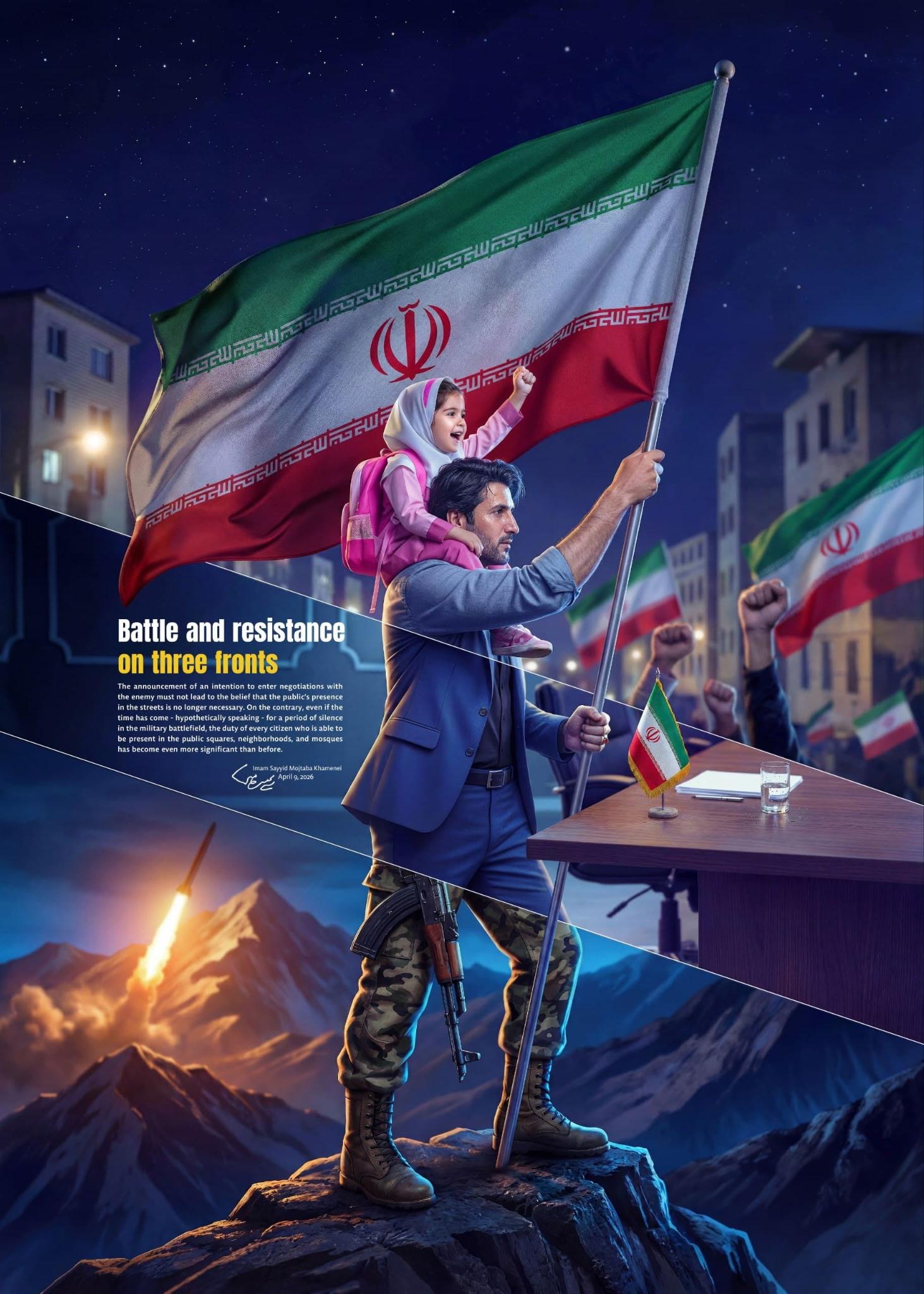
Since the start of the Ramadan War, Iranians have poured into the streets every night to defend the Islamic Republic of Iran against the imperialist onslaught. Their resistance functions on multiple scales as they defend the territorial integrity of the nation, their democratically elected government, and the streets of their major cities following the deadly Mossad and CIA-led urban warfare campaign and coup attempt of January 2026. Though they fight the largest, most powerful empire in world history during the ongoing genocide of the Palestinians, the people of Iran have shown great courage, fortitude and pride in the Islamic Republic of Iran. The Iranian response to imperialism’s third-imposed war since 1979 is one of unrelenting defiance and national unity, rooted in both Iranian history and Shi’i liberation theology.
Iran has faced violent, spectacular U.S.-led assaults on its sovereignty for three quarters of a century. In 1953, the U.S. and the United Kingdom removed Prime Minister Mohammad Mossadegh in the first CIA coup d’etat. Mossadegh was a democratically elected prime minister who rode into office following massive waves of worker strikes across the country, especially in the oil and gas sectors (Stevenson 2025). He immediately nationalized Iranian resources. The U.S. and the U.K. reacted by forcefully removing him from office and replacing him with a vicious monarchy led by Mohammad Reza Pahlavi.
Pahlavi’s regime was characterized by extreme violence and underdevelopment. His secret police, SAVAK, was a joint creation of Israel’s Mossad, the CIA and the FBI, and had unlimited powers of arrest and interrogation (Balan-Gaubert 2026). It terrorized the Iranian public, using imprisonment, torture, and murder of dissidents and other members of the population.
In 1976, during the last few years of the monarchy, the overall literacy rate of the Iranian population was below 40 percent and even lower for women (World Bank 2026). There was little self-sufficiency in food and agriculture as Iranians relied primarily on imports for food (Afshar 1985). The monarchy had transformed Iran into a petro-state that largely benefited Western countries. During this period, Iran faced catastrophic wealth and resource drain that brought about significant poverty.
The exploitation and underdevelopment was so severe that by 1978 a wave of general strikes rocked the country. At the time, observers estimated that the upheavals were the largest general strike in modern history (Iqbal 2009). Strikes were organized by a united front of different social and labor movements and political forces including workers, students and women from nationalist, socialist, and Islamic parties. Strikes lasted many months, and alongside other grassroots activities, they brought about the 1979 Iranian Revolution.
Since then, the United States has waged imperialist, hybrid warfare against Iran, seeking to destabilize and fragment the nation while toppling the Islamic Republic. This campaign includes the U.S-backed Iraqi invasion of Iran in 1980, one of the most severe sanctions regimes in the world, assassinations of political, military, and scientific leaders, civilian infrastructure sabotage, currency devaluation, and the the U.S.-zionist invasion of Iran in the 12-Day War. U.S. military bases have surrounded the Islamic Republic of Iran for its entire existence, and the U.S. has waged long ground wars on both Iraq and Afghanistan, two of Iran’s largest neighbors.
As comprador agents of U.S. imperialism, the Gulf monarchies have actively collaborated in the decades-long assault on Iran through means both conventional and unconventional, including weather warfare. The U.A.E.'s climate research program, which features cloud seeding, appears to be a dimension of U.S.-sponsored weather warfare against Iran, echoing U.S. imperialist strategies deployed during the Vietnam War. In Project Popeye,[2] U.S. forces conducted cloud seeding over North Vietnam to prolong the monsoon season and disrupt supply routes. Now the U.A.E. has developed its own cloud seeding program, ostensibly to increase rainfall over its arid territory. Yet cloud seeding does not create new rain; it redirects it, reducing precipitation downwind. As Iraqi scholar Salam Abdulqadir Abdulrahman explains, seeding clouds in an upwind state effectively seizes rain that would have fallen on a downwind state (Cited in Podur 2026). Reports have surfaced that Iranian defensive attacks damaged the U.A.E.'s climate research centers and set back its weather modification programs during the war. Incidentally, Iran and Iraq have experienced greater rainfall since the war began.
Despite this all-out assault against the Islamic Republic of Iran and its people, Iran has not only survived, it has thrived. The state has managed to direct a significant portion of surplus value to social reproduction and meeting the needs of the popular classes. Iran now has a literacy rate in the 90th percentile for all genders. As of 2019, 80 percent of Iran’s food was from domestic sources (Gang 2019). Close to 95 percent of the population is enrolled in public insurance plans. (Commonwealth Fund 2026). 60 percent of Iranian university students are women. Somewhere between 40 and 70 percent of graduates in science, technology, engineering and math are women. Iran has strong biotechnology, household appliances, automotive, medical, defense and aerospace industries (Tehran Times 2026; PressTV 2025; Trading Economics 2026; Embassy of Iran - Dublin 2026; Pars Today 2025; Agenzia ICE 2025; Embassy of Iran - Mumbai 2026; GlobalSecurity.org 2025). On many of these social indicators—literacy, women's education, public health and access to higher education—Iran's achievements rival those of socialist Cuba.
This material resilience has been matched by a parallel offensive in the global battle of ideas. Iran's viral Lego-style animations, produced by the Tehran-based collective Explosive Media, deploy satire and pop-cultural literacy as anti-imperialist cultural resistance and counter-hegemonic propaganda, exposing the U.S.-zionist war on Iran as a continuation of imperialist violence from Hiroshima to Abu Ghraib (Ramazani, 2026). One emblematic clip depicted flag-draped American coffins floating in the Strait of Hormuz, captioned: "The only American thing that can pass through the Strait of Hormuz" (Telegraph India, 2026). Iran's diplomatic missions have joined this digital counter-offensive, turning embassy X accounts into hubs of viral trolling that mocks Trump's threats and mental acuity, including the Zimbabwe embassy's deadpan "We've lost the keys" in response to Trump's demand to open the Strait, the South African embassy urging U.S. officials to invoke the 25th Amendment, and the Hungarian embassy's AI parody of Trump hopelessly wedging a Cybertruck in the Hormuz chokepoint (Mansour 2026; Sikora and Bodnar 2026; ANI2026). So effective has this cultural offensive been that YouTube banned the Explosive Media channel under the guise of "violent content," a transparent move to suppress the truth about its criminal war (Ramazani, 2026). Diplomatic cables revealed by Politico (2026) confirm the strategic impact, demonstrating how anxious U.S. embassies are about diminishing U.S. soft power and the ability to shape the narrative through imperialist propaganda.
This counter-offensive in the battle of ideas is rooted in and sustained by a vibrant, creative, organized, and politically conscious society. Iran has many daily newspapers and magazines, multiple political parties routinely represented in local and national elections, and a strong legal system. There are active student, women’s, and labor movements that regularly make policy demands upon the state. This is why the Iranian masses stand so strongly behind the Islamic Republic of Iran and continue to wage a People’s War against the forces of imperialist-zionism. Through their nightly protests in support of the state and the IRGC, the Iranian people demonstrate their will to form a popular cradle around the forces of resistance and deterrence. In doing so, these rallies identify and resist U.S. imperialism as the primary contradiction.
IV. Multipolarity as Anti-Imperialist Delinking
The war on Iran is not only a U.S. attempt to reassert its dominance over West Asia in the face of imperialist decline, it is also part of a broader struggle over the future of the global order itself. Since the 1970s, U.S. hegemony has rested heavily on the petrodollar system whereby global oil sales were priced and settled in dollars and then recycled into U.S. Treasury bonds and dollar-denominated financial markets. This “Oil-Dollar-Wall Street complex” enabled Washington to maintain the dollar as the world’s reserve currency, which allowed it to finance massive deficits, impose sanctions, and project military power across the globe (Tricontinental: Institute for Social Research 2026). For decades, the U.S. enforced this order through military bases and alliances, naval control over strategic chokepoints, and wars or coups against states seeking greater control over their own resources and national development.
With every passing day, however, new material challenges to this system emerge on the world scale. Iran’s growing integration into BRICS+ and its expanding strategic relationships with China and Russia are examples of the tectonic reordering of economic and political centers of gravity and alliances. This dialectical process underpins the emergence of a multipolar world order. As discussed in the previous section on Iran's resistance economy, the U.S.-led sanctions regime has encouraged, paradoxically, Global Majority states to develop resistance economy strategies, specifically delinking and alternative financial integration mechanisms, sometimes by design and sometimes by necessity.
For example, the new Russia-Iran strategic partnership pact, signed in Moscow in January 2025, is a comprehensive agreement that deepens cooperation between the two countries in energy, trade, intelligence sharing, military-technical coordination, transportation infrastructure, and regional security in response to escalating Western sanctions and military aggression (Escobar 2025). Although bilateral, the pact is embedded within a broader Russia-Iran-China alignment through BRICS+, the Shanghai Cooperation Organization, Belt and Road integration projects, and expanding Eurasian political, military, and economic coordination. This trajectory has only accelerated as Russia and China have moved to formalize a shared geopolitical vision beyond bilateral cooperation alone. In a recent joint declaration signed in Beijing, Vladimir Putin and Xi Jinping reaffirmed a commitment to building a "multipolar world" through deeper coordination in trade, energy, international institutions, and strategic development, presenting a united challenge to U.S. unilateralism and further consolidating the political foundations of an emergent Eurasian order (The Moscow Times 2026).
North Korea has also emerged as a key node in this anti-imperialist axis. In February 2026, North Korea, Iran, Russia, and Belarus formally declared their intent to develop a "Eurasian Charter of Diversity and Multipolarity," aiming to challenge Western dominance by promoting a new security framework and fostering economic alternatives to international sanctions (BelTA 2026). Pyongyang has declared its intent to provide support to Iran, as weapons supplier for Tehran in response to zionist-imperialist strikes. This builds on a decades-long history of missile technology sharing between the two nations, which has contributed to Iran’s domestic production capabilities, in particular for developing Scud, Nodong, and Musudan-derived missiles (UPI 2026). It also builds on both countries’ commitment to self-reliance, expressed in North Korea by their juche (self-reliance) philosophy.
China's role in this emerging multipolar order is not defined by kinetic military intervention in West Asia but by a strategic, multi-dimensional counter-offensive against the architecture of U.S. imperialism itself. As K.J. Noh argues, rather than being drawn into a direct conflict, which would play to U.S. strengths in expeditionary warfare, China has chosen to build the infrastructure of sovereignty for the Global South: digital sovereignty through Huawei's digital silk road, financial sovereignty through alternatives to the U.S.-dominated SWIFT system, and energy sovereignty by helping anti-imperialist, actually existing socialist states like Cuba break free from imperial strangleholds (Noh 2026).
In many ways, the war on Iran is also a war on China. In Noh’s words, the U.S. ruling class has long conceived of its global dominance in terms of a “three-course meal.” Russia as the “appetizer” to be polished off quickly, Iran as “dessert,” and China as the “main dish.” This sequencing, however, has backfired catastrophically. Russia depleted Western weapons stockpiles and political will. Iran then delivered the gut punch—blinding U.S. radar systems, exhausting interceptor magazines, and exposing the unsustainability of a high-tech, low-volume U.S. arms production model that cannot be replenished due to imperialist decline and decades of de-industrialization. By the time the empire turns to face China, it will have already shot its bolt, facing an industrial power that has spent fifty years preparing for this confrontation while the U.S. can no longer manufacture the missiles it needs to fight (Losier 2025).
It is precisely these emerging material realities, including Iran's control over the Strait of Hormuz, the consolidation of South-South cooperation, and the construction of parallel financial and energy architectures, that directly threaten the mechanisms through which the imperialist core has historically disciplined Global Majority states and maintained polarized accumulation on a world scale. Iran's willingness to link safe passage through the Strait to non-dollar trade arrangements, China's Belt and Road Initiative, and the rise of Eurasian integration projects all point toward alternative trade corridors, financial arrangements, and development models less dependent on U.S. imperialist dominated institutions. In this sense, the war on Iran is a war on multipolarity itself: an attempt to preserve a declining unipolar order by force, to contain China's rise as a major actor in an emergent polycentric world by denying it access to resources and trade, and to eliminate alternative centers of political and economic power outside the orbit of U.S. imperialism.
V. The Diplomatic Front: Anti-Imperialist Foreign Policy
The Ramadan War developed within a long history of anti-imperialist struggles against diplomatic duplicity by imperial powers. The revolutionary Chinese leader Mao Zedong famously postulated that “politics is war without bloodshed while war is politics with bloodshed” (Zedong 2013). More than a hundred years earlier, the revolutionary Haitian leader Jean-Jacques Dessalines proclaimed in 1804 that his country’s thirteen-year liberation struggle against France faced its greatest challenge not from French imperialist armies but from the “Chicanery of the Proclamations of their Agents” (Gaffield 2013). Imperialist duplicity is as old as the West itself and yet every revolutionary movement has understood that diplomacy is part and parcel of the struggle for liberation. The South African revolutionary Chris Hani asserted that diplomacy is in the arena of struggle. As the leader of Umkhonto we Sizwe, the armed wing of the African National Congress, Hani understood the intrinsic relationship between warfare and diplomacy, and he was indeed assassinated by agents of the apartheid regime during the negotiation process for transition to Black majority rule (Smith 2019).
During the ceasefire negotiations in Islamabad in April 2026, Iran’s lead negotiator and Speaker of Parliament Mohammad Ghalibaf affirmed that diplomacy is a method of struggle that coexists “alongside military struggle to secure the rights of the Iranian nation” (Newsroom 2026). Despite U.S. diplomatic chicanery against Iran on three separate occasions in the past decade, Iran recognized the importance of the negotiating table to secure gains on the battlefield. This willingness to negotiate does not rely on trust in U.S. veracity. Rather, it provides diplomatic leverage that strengthens Iran’s position on the battlefield and the diplomatic positions of its partners in the emerging multipolar world, just as strategic gains provide greater leverage at the negotiating table.
The first act of U.S. diplomatic treachery against Iran came in the wake of the Joint Comprehensive Plan of Action agreement in 2015, which included China, Russia, and the E3 (France, Germany, and the United Kingdom). As part of JCPOA, Iran agreed to limit nuclear enrichment of its existing uranium stockpile to 3.67 percent for a fifteen-year period in exchange for sanctions relief and reintegration into the global economy. In January 2017, President Donald Trump annulled the nuclear agreement; the U.S. withdrew from the agreement in 2018. The U.S. then imposed a regime of “maximum pressure” sanctions on Iran to eliminate its oil exports to China and other countries. These policy decisions, which continued under the Joseph Biden government, compelled Iran to continue nuclear enrichment. By 2025, Iran reportedly had over 400 kilograms of highly enriched uranium (over 60 percent of the threshold for weapons grade enrichment).
Iran reentered negotiations with the United States at the beginning of Trump’s second term in early 2025. Washington demanded that Iran discontinue enrichment and relinquish its highly enriched uranium to the International Atomic Energy Agency, dismantle its ballistic missile program, and sever ties with its regional allies in the Axis of Resistance. Each demand challenged Iran’s sovereign rights. The nuclear program embodied decades of indigenous research and development and the ballistic missile program was central to Iran’s national defense(Zein 2025). Iran refused to compromise its sovereignty during five rounds of negotiations in the first half of 2025. A sixth meeting was scheduled but it was thwarted by the U.S.-backed zionist attack on Iran on June 13, initiating the 12-Day War. Washington was not only aware of the blitzkrieg attack in advance, but U.S. officials had coordinated the attack with "Israel" in the preceding months (Berman 2025). Trump even gloated that he was “very much in charge” of the zionist attacks against Iran (Osgood & Harb 2025). The zionist-imperialist treachery was also evident in the fact that IAEA Director General Rafael Grossi and aspiring UN Secretary General leaked information about Iran’s nuclear program to the zionist entity, likely with the knowledge that the latter would attack Iran (Jangdost 2025).
Indeed, the 12-Day War crescendoed with U.S. strikes against Iranian nuclear facilities at Natanz, Isfahan, and Fordow. Washington repeatedly claimed to have “obliterated” Iran’s nuclear program with no evidence to support the claim. After experiencing twelve days of sustained assault and despite being the aggressor in the war, the zionist entity enlisted the U.S. to call for a cessation of hostilities on June 24. Iran imposed a strategic defeat on the zionist regime.
Tehran and Washington relaunched negotiations in early 2026, with the U.S. repeating its maximalist demands. Faulty zionist-imperialist intelligence that Iran’s military and defensive capacities had been significantly degraded following the 12-Day War and overconfidence produced by the U.S. kidnapping operation against Venezuelan President Nicolás Maduro and First Combatant Cilia Flores in early January 2026 likely figured into the U.S. decision to attack Iran again on February 28. Instead of crippling Iran or toppling its government in a quick war, the U.S. faced unprecedented defensive and deterrence attacks against its military bases, economic assets, and personnel across the West Asia region. By the time of the April 7th ceasefire, the U.S. had not achieved any of its objectives and Iran’s battlefield successes expanded its diplomatic leverage, including by rejecting unfairly constraining provisions in JCPOA. In short, Iran recalibrated its negotiation strategy to match its battlefield strength (Farnia 2025).
When the Iranian negotiating team arrived in Islamabad on April 11th, it was under no illusions about imperialist duplicity. They knew the risks of assassination, continuation of the war, and that the negotiations could fail. Nevertheless, the Iranian delegation projected great strength, entering Islamabad with scientists, economists, and other experts ready to either secure Iranian and regional sovereignty or walk away based on their battlefield gains and with the support of Iranians and Iran’s allies in the emerging multipolar world order. Iran has proven itself capable of defending its national sovereignty against the U.S. empire and its proxies and allies, meeting force with force. It has positioned itself with dignity as a strong anti-imperialist ally for other anti-imperialist and anti-colonial resistance movements.
Conclusion
West Asia has been under the direct control of Western imperialism for over a century, beginning with the era of the "capitulations" and consolidated by the collapse of the Ottoman Empire and the imposition of the Sykes-Picot Accord (Thomas, 2025). In the 20th century, the region's vast oil and gas reserves powered U.S. imperialism across the globe. After the Arab defeat of the 1967 Naksa (setback), Saudi Arabia and other Gulf states acceded to the petrodollar-security arrangement, which has anchored U.S. imperialism to this day (Rogelberg 2026).The imperialist destruction of the Soviet Union likewise accelerated the empire's military dominance in West Asia. Through wars and sanctions, the U.S. acquired significant control of oil and gas reserves in the region. By pinning its currency to a resource over which it seized overwhelming control, the United States achieved near total economic domination over the global financial system. But the era of U.S. global financial and military domination is now coming to an end.
In mere weeks, the Islamic Republic of Iran has pierced the veil of U.S. military invincibility in West Asia and exposed the limits of its financial and economic warfare through a multi-pronged strategy that targeted U.S. military, economic, industrial, technological, and diplomatic might in the region. The intrinsic weakness of U.S. partners in the Gulf Cooperation Council was laid bare as they were incapable of deterring Iran's retaliation strikes on U.S.-integrated infrastructures in the region. Worse yet, the Gulf countries discovered that U.S. promises of security guarantees were but empty rhetoric, as U.S.-zionist interests betrayed Gulf partners as soon as they launched their war of aggression. During the war, the zionist entity faced the most severe military attacks it has ever experienced—amassing U.S. defenses toward the zionist entity while leaving Gulf partners vulnerable to direct hits.
Equally significant, Iranian and Omani sovereignty over the Strait of Hormuz erodes the U.S. petrodollar system that has subjugated the world for over half a century. This erosion of dollar hegemony is part of a broader pattern this red paper has identified as anti-imperialist delinking, forming the material basis of an emergent multipolar world order. It is within this historical and geopolitical context that we must understand Iranian anti-imperialism.
The Islamic Republic of Iran, as a near-peer adversary of the United States, is waging a regional war against all the assets of U.S. imperialism in western Asia. Its objective is the removal of U.S. imperialism from the region, and from the Global Majority more generally. It is thus a war for the fate of Palestine, and a war that belongs to all those terrorized by U.S. imperialism, from the southern shores of Africa to Russia in the north, China and Korea in the east and Cuba and Venezuela in the west. It is a war for the colonized and subjugated peoples of Turtle Island, victimized by North American continental imperialism. The Ramadan War is a continuation of the Islamic Revolution of Iran, but it is now humanity’s revolutionary war. As Iran stands tall, we too stand shoulder-to-shoulder with the courageous people of the region. The fate of the planet demands no less.
Notes
[1] We recognize the colonial roots of International Law and that the United Nations is complicit in the Western imperialist project, but make this point to establish that even under the imperialist system of international law, Iran has a recognized right to self-defense and is not the aggressor.
[2] A State Department memorandum, dated January 13, 1967, details the proposed plan that was subsequently implemented: “The objective of the program is to produce sufficient rainfall along these lines of communication to interdict or at least interfere with truck traffic between North and South Vietnam. Recently improved cloud seeding techniques would be applied on a sustained basis, in a non-publicized effort to induce continued rainfall through the months of the normal dry season” (Office of the Historian January 13, 1964).
Bibliography
"4.5% Increase in Home Appliance Exports in H1." Agenzia ICE, 26 Oct. 2025, www.ice.it/it/news/notizie-dal-mondo/294413 .
"Iran's Deterrence Power Strengthened after Ballistic Missile Upgrades: Top General." PressTV, 5 Feb. 2026, www.presstv.ir/Detail/2026/02/05/763538/Iran-deterrence-power-ballistic-missiles .
"50 Iranian Hospitals Damaged in U.S.-Israeli Attacks: Health Minister." PressTV, 27 Apr. 2026, www.presstv.ir/Detail/2026/04/27/767645/50-Iranian-hospitals-damaged-in-U.S.-Israeli-attacks-Health-minister .
"274. Memorandum From the Deputy Under Secretary of State for Political Affairs (Kohler) to Secretary of State Rusk." Office of the Historian, 13 Jan. 1967, history.state.gov/historicaldocuments/frus1964-68v28/d274 .
"2015 Joint Comprehensive Plan of Action (JCPOA)." EEAS, 14 July 2015, eeas.europa.eu/archives/docs/statements-eeas/docs/iran_agreement/iran_joint-comprehensive-plan-of-action_en.pdf .
"310 Students and Teachers Killed, over 750 Schools Damaged in U.S.-Israeli War on Iran." PressTV, 7 Apr. 2026, www.presstv.ir/Detail/2026/04/07/766430/310-students-and-teachers-killed,-over-750-schools-damaged-in-US-Israeli-war-on-Iran .
"Advancing Iran's Position in the Field of Cell Therapy Worldwide / Self-sufficiency in Insulin within 2 Years." Pars Today, 12 Aug. 2025, parstoday.ir/en/news/iran-i237716-advancing_iran%E2%80%99s_position_in_the_field_of_cell_therapy_worldwide_self_sufficiency_in_insulin_within_2_years .
Abas al-Zein. "From the War of the Cities to True Promise 3: Iran's Ballistic Program and the Path to Networked Deterrence." The Cradle, 28 June 2025, thecradle.co/articles/from-the-war-of-the-cities-to-true-promise-3-irans-ballistic-program-and-the-path-to-networked-deterrence .
Abbaszadeh, Hassan. "95 percent of fixed petrochemical equipment was domestically manufactured." Iran Energy Press. December 6, 2025. https://energypress.ir/en/95-percent-of-fixed-petrochemical-equipment-was-domestically-manufactured/ .
Afshar, Haleh. "An Assessment of Agricultural Development Policies in Iran." Science Direct, no. 11–12, Nov. 1985, pp. 1097–1108, doi.org/10.1007/978-1-349-17966-4_4 .
Ali Khamenei, Sayyid. "Ayatollah Khamenei Announces General Policies on the Economy of Resistance." Khamenei.ir , 18 Feb. 2014, english.khamenei.ir/news/5396/Ayatollah-Khamenei-Announces-General-Policies-on-the-Economy-of-Resistance .
Amin, Samir. "Beyond Liberal Globalization." Monthly Review, vol. 58, no. 7, 2006, p. 48.
Amin, Samir. Capitalism in the Age of Globalization. Zed Books, 2014, p. 40.
Amin, Samir. Delinking: Towards a Polycentric World. Zed Books, 1990, pp. 62–67.
Angelo, Jake. "'The Biggest Energy Security Threat in History': IEA Chief Warns 13 Million Barrels a Day Are Gone with No Cure in Sight." Fortune, 23 Apr. 2026.
ANI News. "‘Hopelessly wedged’: Iranian mission mocks Trump with AI parody of Strait of Hormuz ‘chokepoint.’" May 8, 2026. https://aninews.in/news/world/europe/hopelessly-wedged-iranian-mission-mocks-trump-with-ai-parody-of-strait-of-hormuz-chokepoint20260508113312/ .
Arranz, Adolfo, et al. "Cheap Drones Are Reshaping the War in the Sky." Reuters, 17 Mar. 2026, www.reuters.com/graphics/IRAN-CRISIS/DRONES/dwpkyamxqpm .
Aryahi, Ghazal. "'Permanent Scar': Iran Minister on U.S.-Israeli Attacks on Monuments." Al Jazeera, 1 Apr. 2026, www.aljazeera.com/features/2026/4/1/irans-minister-civilisational-identity-under-fire-in-unprecedented-war .
Ashcroft v. Iqbal. U.S. Supreme Court, 16 June 2009.
Balan-Gaubert, William. "Empire by Proxy: Paramilitarism, Authoritarianism, and U.S. Cold War Power in Haiti and Iran." Anti-imperialists, 31 Jan. 2026, www.anti-imperialists.com/magazine/empire-by-proxy-paramilitarism-authoritarianism-and-us-cold-war-power-in-haiti-and-iran .
Bazilian, Morgan, et al. "The Chokepoint We Missed: Sulfur, Hormuz, and the Threats to Military Readiness." Modern War Institute, 13 Mar. 2026, mwi.westpoint.edu/the-chokepoint-we-missed-sulfur-hormuz-and-the-threats-to-military-readiness .
BelTA. "Belarus, Iran, North Korea, Myanmar, Russia on Way to Eurasian Charter of Diversity, Multipolarity." BelTA – News, 3 Feb. 2026, eng.belta.by/politics/view/belarus-iran-north-korea-myanmar-russia-on-way-to-eurasian-charter-of-diversity-multipolarity-176493-2026 .
Berman, Lazar. "Report: Netanyahu, Trump Planned Iran Strike Far in Advance, Ran Deception Campaign." Times of Israel, 17 Dec. 2025, www.timesofisrael.com/report-netanyahu-trump-planned-iran-strike-far-in-advance-ran-deception-campaign .
Business Insider. "Hand Woven with the Finest Materials Including Wool and Silk, a Single Persian Rug Can Often Take Years, and Sometimes Decades to Create." Facebook, 25 May 2022, www.facebook.com/watch/?v=1146341212603509 .
Chakrabarty, Roshni. "Iran Has Two Armies: What Is the IRGC and Why It Matters." India Today, 3 Mar. 2026, www.indiatoday.in/amp/education-today/gk-current-affairs/story/what-is-the-irgc-irans-dual-military-structure-explained-2876892-2026-03-03 .
Clark, D. "Iran - Share of Economic Sectors in Gross Domestic Product (GDP) 2023." Statista, 30 Apr. 2026, www.statista.com/statistics/294534/iran-share-of-economic-sectors-in-gdp .
Commonwealth Fund. (2026, April 30). Iran | International Health Policy Center. https://www.commonwealthfund.org/international-health-policy-center/countries/iran .
D'Urso, Stefano. "Report Claims Iranian F-5 Bombed U.S. Base in Kuwait during Opening Phase of War." The Aviationist, 26 Apr. 2026, theaviationist.com/2026/04/26/report-claims-iranian-f-5-bombed-us-base .
Eaglesham, Jean. "Insurers Tighten Requirements for Ships in Strait of Hormuz." The Wall Street Journal, 28 Apr. 2026, www.wsj.com/livecoverage/iran-war-strait-of-hormuz-2026/card/insurers-tighten-requirements-for-ships-in-strait-of-hormuz-wzABOacCdLEkidP1rjWi .
Ebrahim Azizi. "Reliance on Rented Security from Foreign Powers Is Nothing More than a Mirage..." X, 7 May 2026, 3:05 p.m., twitter.com/Ebrahimazizi33/status/2052464870470341029 .
Ellis-Jones, Ian. "Operation Epic Fury U.S. Aircraft Losses Visualized." The War Zone, 10 Apr. 2026, www.twz.com/air/operation-epic-fury-u-s-aircraft-losses-visualized .
Escobar, Pepe. "Russia–Iran–China: All for One, and One for All?" The Cradle, 8 Apr. 2025, thecradle.co/articles/russia-iran-china-all-for-one-and-one-for-all .
Farnia, Navid. "Iran's 12-Day War of Resistance: National Liberation as Self-Reliance." Middle East Critique, vol. 34, no. 4, 8 Oct. 2025, pp. 803–14, doi.org/10.1080/19436149.2025.2576356 .
Farnia, Navid. "On Fighting and Talking: Lessons from Viet Nam's Victories over Two Empires." Anti-imperialists, 31 Dec. 2025, www.anti-imperialists.com/magazine/on-fighting-and-talking-lessons-from-viet-nam-s-victories-over-two-empires .
Farzanegan, Mohammad. "Oil Revenue Shocks and Government Spending Behavior in Iran." Science Direct, Nov. 2011, www.sciencedirect.com/science/article/abs/pii/S0140988311001101 .
France 24 English. "Companies Evacuate Dubai Financial District after Iran Threats." YouTube, 2026, www.youtube.com/watch?v=5gOf8aL5YFM .
Gaffield, Julia. "English Translation of the Haitidoi." Haiti and the Atlantic World, 2 Aug. 2013, haitidoi.com/2013/08/02/english-translation-of-the-haitidoi .
Gang, Ding. "Self-Sufficiency Helps Iran Counter Sanctions." Global Times, 15 May 2019, www.globaltimes.cn/page/201905/1150016.shtml .
Ghasemi Tari, Zeinab. “Challenging the Proxy Narrative: Hezbollah, Iran, and the Reimangining of Islamic Resistance in the Ummah,” Middle East Critique, 9 July 2025, https://www.tandfonline.com/doi/full/10.1080/19436149.2025.2524643 .
Giáp, Võ Nguyên. (1962). People's war, people's army. Frederick A. Praeger.
Gibbons-Neff, Thomas. "Placing U.S. Troops in Middle East Hotels May Violate Laws of War." The New York Times, 1 Apr. 2026, www.nytimes.com/2026/04/01/us/politics/troops-iran-hotels.html .
Gross, Samatha. "The Iran Conflict's Energy Shocks Are Not Yet Fully Realized." Brookings, 1 Apr. 2026, www.brookings.edu/articles/the-iran-conflicts-energy-shocks-are-not-yet-fully-realized .
Hajizadeh, A. "Imam Khamenei's Decisions Changed the Course of Our Military: In the Military We Are at a Global Level." Khamenei.ir , 15 July 2025, english.khamenei.ir/news/11803/Imam-Khamenei-s-decisions-changed-the-course-of-our-military .
Heidari, Saeed. "South Pars refineries' over 11,000 equipment items produced domestically." Tehran Times. January 29, 2025. https://www.tehrantimes.com/print/509173/South-Pars-refineries-over-11-000-equipment-items-produced-domestically .
Honrada, Gabriel. "U.S. Diverts JASSM-ER Missiles to Iran, Risking Deterrence vs China." Asia Times, 7 Apr. 2026, asiatimes.com/2026/04/us-diverts-jassm-er-missiles-to-iran-risking-deterrence-vs-china .
"Hospitals Equipped with 95% Iranian-Made Systems." Embassy of the Islamic Republic of Iran - Dublin, 19 Apr. 2026, ireland.mfa.gov.ir/en/NewsView/718618/Hospitals-equipped-with-95-Iranian-made-systems .
"IEA Member Countries to Carry Out Largest Ever Oil Stock Release amid Market Disruptions from Middle East Conflict." IEA, 11 Mar. 2026, www.iea.org/news/iea-member-countries-to-carry-out-largest-ever-oil-stock-release-amid-market-disruptions-from-middle-east-conflict .
International Monetary Fund. "Chapter 2: The Financial Sector - Issues and Reforms." IMF eLibrary, 1 Mar. 2007, www.elibrary.imf.org/display/book/9781589064416/ch002.xml .
"Iran Army Achieves Self-Sufficiency in Critical Aerospace Parts Manufacturing: Top Commander." GlobalSecurity.org , 2 June 2025, www.globalsecurity.org/wmd/library/news/iran/2025/iran-250602-presstv04.htm .
"Iran at a Glance." FAO, 2026, www.fao.org/iran/our-office/iran-at-a-glance/en .
"Iran Capable of Exporting Missiles: Top Iranian Cmdr." Tehran Times, 11 Oct. 2025, www.tehrantimes.com/news/518985/Iran-capable-of-exporting-missiles-Top-Iranian-Cmdr .
"Iran Car Production." Trading Economics, 2026,tradingeconomics.com/iran/car-production .
"Iran Doesn't Trust Enemy Given Past Experiences: Ghalibaf." Mehr News Agency, 9 Apr. 2026, en.mehrnews.com/news/243462/Iran-doesn-t-trust-enemy-given-past-experiences-Ghalibaf .
"Iran Earns $400m from Date Exports, Ranks 2nd in Global Production." Tehran Times, 15 Feb. 2025, www.tehrantimes.com/news/509773/Iran-earns-400m-from-date-exports-ranks-2nd-in-global-production .
"Iran Has Right to Control Strait of Hormuz, Says Russia's UN Envoy." United News of India, 28 Apr. 2026, uniindia.com/~/iran-has-right-to-control-strait-of-hormuz-says-russia-s-un-envoy/World/news/3825132.html .
"Iran Health Expo 2025: A Global Platform for Medical Innovation." Embassy of the Islamic Republic of Iran - Mumbai, 7 May 2026, mumbai.mfa.gov.ir/en/newsview/761685/Iran-Health-Expo-2025-A-Global-Platform-for-Medical-Innovation .
"Iran Parliament Advances Legislation on 'New Legal Regime' in Hormuz Strait." PressTV, 21 Apr. 2026, www.presstv.ir/Detail/2026/04/21/767286/Iran-Parliament-advances-legislation-on-new-legal-regime-in-Hormuz-Strait .
"Iran Ranks Fourth Globally in Sheep and Livestock Production." TV BRICS, 8 Apr. 2025, tvbrics.com/en/news/iran-ranks-fourth-globally-in-sheep-and-livestock-production .
"Iran Releases Final Death Toll of 'Ramadan War': 3,375 Killed." WANA, 20 Apr. 2026, wanaen.com/iran-releases-final-death-toll-of-ramadan-war-3375-killed .
"Iran Share of Industry." TheGlobalEconomy, 2024, www.theglobaleconomy.com/Iran/share_of_industry .
"Iran's Endurance Strategy." Tehran Times, 6 Mar. 2026, www.tehrantimes.com/news/524492/Iran-s-endurance-strategy .
Jaafari, Shirin. "More Civilian Casualties Come to Light from a Strike That Hit a Sports Hall Killing Children in Southern Iran." The World from PRX, 27 Mar. 2026, theworld.org/stories/2026/03/27/more-civilian-casualties-come-to-light-from-a-strike-that-hit-a-sports-hall-killing-children-in-southern-iran .
Jangadost, Mohammed. "Tehran Publishes Leaked Data, Claims Israel Monitored UN Nuclear Watchdog." Channel 8, 25 Sept. 2025, channel8.com/english/news/45393 .
Kadri, Ali. China's Path to Development. Springer Nature Link, 2021.
Kadri, Ali. "Neoliberalism vs. China as a Model for the Developing World." The Ideas Working Paper Series, no. 01/2020, p. 21.
Kassir, Kassem. "The Phrases 'Unity of Fields [of Battle]', 'Unity of Fronts' or 'Axis of Resistance.'" Institute of Palestine Studies, 20 Nov. 2023, www.palestine-studies.org/en/node/1654679 .
"Literacy Rate, Adult Total (% of People Ages 15 and above) - Iran, Islamic Rep." World Bank Open Data, 19 Mar. 2026, data.worldbank.org/indicator/SE.ADT.LITR.ZS?locations=IR .
Losier, Toussaint. “Pursuing a Third World War in Pieces: The 12-Day War in the Context of US Grand Strategy.” Middle East Critique, vol. 34, no. 4, November 10, 2025, pp. 815-821, https://doi.org/10.1080/19436149.2025.2573571 .
Mansour, Mohammad. "‘Get a grip’: How Iranian embassies mocked Trump’s vulgar threat." Al Jazeera, April 7, 2026. https://www.aljazeera.com/news/2026/4/7/get-a-grip-how-iranian-embassies-mocked-trumps-vulgar-threat .
Marandi. "Prof. Marandi on Iran's Nuclear Program: 'They Will Not Give Trump a Deal Better than That of Obama.'" YouTube, 9 May 2026, www.youtube.com/watch?v=GojYRV_df8k .
McCartney, Micah. "China Oil Tankers Break Out of Strait of Hormuz via Iran 'Tollbooth.'" Newsweek, 13 Apr. 2026, www.newsweek.com/china-oil-tankers-break-strait-hormuz-iran-tollbooth-11819332 .
MintPress News. "BREAKING: A Second Syrian Armed Group Declares War on Israel." X, 1 Apr. 2026, 3:23 p.m., twitter.com/MintPressNews/status/2039423544115827174 .
MMR Statistics Research Team. "Global Saffron Market Size & Growth Opportunities 2025–2032: Rising Demand for Premium Spices and Organic Cultivation to Drive Sustainable Growth." MMR Statistics, 22 Jan. 2026, www.mmrstatistics.com/reports/234879/global-saffron-market .
"More Details Emerge About the 'Toll' at the Strait of Hormuz." World Ports Organization, 3 Apr. 2026, www.worldports.org/more-details-emerge-about-the-toll-at-the-strait-of-hormuz .
Moreira da Silva, Jorge. "Strait of Hormuz: With Hunger Looming, Life-Saving Fertilizer Shipments Cannot Wait, Head of UN Task Force Says." United Nations, 21 Apr. 2026, news.un.org/en/interview/2026/04/1167351 .
Nigerian Journal of Sustainability Research (NJSR). "42 Aircraft, $2.6 Billion, 40 Days: The Full Story of U.S. Aviation Losses in the 2026 Iran War." May 19, 2026. https://njsr.com.ng/index.php/home/announcement/view/180 .
NDTV World Staff. "Iran News | Two Weeks of War: U.S. Loses F-15E Fighters, Reaper Drones & Missile Warning Radar." NDTV World, 13 Mar. 2026, youtube.com/shorts/gA2PHRkL1s8 .
Nereim, Vivian. "Gulf Countries Arrest Shiite 'Traitors' amid War with Iran." The New York Times, 13 May 2026, www.nytimes.com/2026/05/13/world/middleeast/gulf-countries-arrest-shiite.html .
News Desk. "Hezbollah Turns South Lebanon into 'Graveyard' for Israeli Tanks, Breaks Record for Daily Operations." The Cradle, 26 Mar. 2026, thecradle.co/articles/hezbollah-turns-south-lebanon-into-graveyard-for-israeli-tanks-breaks-record-for-daily-operations .
Newsroom. "U.S. Failed to Gain Tehran's Trust in Islamabad, Says Iran's Chief Negotiator." Türkiye Today, 12 Apr. 2026, www.turkiyetoday.com/region/us-failed-to-gain-irans-trust-in-islamabad-says-ghalibaf-3217937 .
Noh, K.J. "From West Asia to East Asia - U.S. War Is Heading to China." The Cradle, uploaded by The Cradle, 30 Apr. 2026, youtu.be/hilaqLkw-00?t=1437 .
Osgood, Brian, and Ali Harb. "Updates: Trump Says He Was 'Very Much in Charge' of Israel's Attack on Iran." Al Jazeera, 6 Nov. 2025, www.aljazeera.com/news/liveblog/2025/11/6/trump-live-us-shutdown-sends-airlines-scrambling-flights-may-be-cut .
Palestine Chronicle Staff. "'Alarmingly Low': U.S. Burns Through Tomahawks as War Drains Missile Stocks." Palestine Chronicle, 27 May 2026, www.palestinechronicle.com/alarmingly-low-us-burns-through-tomahawks-as-war-drains-missile-stocks .
"Pistachio Export Stands at $730m in 9 Months." Tehran Times, 13 Feb. 2026, www.tehrantimes.com/news/523712/Pistachio-export-stands-at-730m-in-9-moths .
Podur, Justin. "Did the War Disrupt Weather Modification on Iran? Speculations about Post-War Rainfall." The Anti-Empire Project, 23 Apr. 2026, justinpodur.substack.com/p/did-the-war-disrupt-weather-modification .
Politico. (2026, April 17). “Diplomatic cables show Iran war is damaging U.S. on multiple fronts across the world.” https://www.politico.com/news/2026/04/17/embassy-cables-detail-how-iran-war-is-hurting-the-us-abroad-00877205 .
Power, John. "In Strait of Hormuz, Iran and China Take Aim at U.S. Dollar Hegemony." Al Jazeera, 8 Apr. 2026, www.aljazeera.com/economy/2026/4/8/in-strait-of-hormuz-iran-and-china-take-aim-at-us-dollar-hegemony .
Press TV. "The Success Story Behind Iran's Home Appliance Revival." PressTV, 12 Nov. 2025, www.presstv.ir/Detail/2025/11/12/758672/The-success-story-behind-Iran%E2%80%99s-home-appliance-revival .
Public Affairs Staff. "CIA's Role in Forming SAVAK." CIA, 2 Mar. 1980, www.cia.gov/readingroom/docs/CIA-RDP90-00552R000505290007-5.pdf .
Ramazani, Yousef. "Defeated at War, Desperate Enemy Bombs Iran's Century-Old Biomedical Research Center." PressTV, 4 Apr. 2026, www.presstv.ir/Detail/2026/04/04/766286/defeated-war-desperate-enemy-bombs-iran-105-year-biomedical-research-center .
Ramazani, Yousef. "Iran's LEGO animations crushed enemy war narratives – so YouTube banned them." PressTV, April 17, 2026. https://www.presstv.ir/Detail/2026/04/15/766953/iran-lego-animations-crushed-enemy-war-narratives-youtube-banned-them .
"Report: North Korea Shared Missile Tech with Iran for Decades." UPI, 1 May 2026, www.upi.com/Top_News/World-News/2026/05/01/transferred-missile-technology-to-iran/5371777683724 .
Rogelberg, Sasha. "2 Years Ago, Saudi Arabia Quietly Canceled the 'Petrodollar' Deal with America That Wired the World Economy for 50 Years. Then War Broke Out in Iran." Fortune, 7 Apr. 2026, fortune.com/2026/04/07/what-is-petrodollar-petroyuan-saudi-china-dollar-strength .
Rome, Henry. "Iran's Revolution at 43: The Economy." The Iran Primer, 9 Feb. 2022, iranprimer.usip.org/blog/2022/feb/09/irans-revolution-43-economy .
Sadeqi Mohammadi, Setareh, and Christopher Weaver. "Resistance Economies: An Analysis of Resilience against U.S. Sanctions on Iran and Cuba." Middle East Critique, published online June 5, 2025.
Saqafi, Hamidreza. "Cumulative gas production at South Pars Phase 11 triples." ICE Teheran (Agenzia ICE). August 21, 2025. https://www.ice.it/it/news/notizie-dal-mondo/290324 .
Sayyari, Habibollah. "Iran Manufactures over 90% of Own Defense Equipment." Mehr News Agency, 14 Feb. 2025, en.mehrnews.com/news/228302/Iran-manufactures-over-90-of-own-defense-equipment .
Sharma, Yashraj. "When Will Strait of Hormuz Be 'Safe' for Commercial Shipping Again?" Al Jazeera, 28 Apr. 2026, www.aljazeera.com/features/2026/4/28/when-will-strait-of-hormuz-be-safe-for-commercial-shipping-again .
Sikora, Krysia, and Joseph Bodnar. "Iran's diplomats launch a meme war." Institute for Strategic Dialogue, April 23, 2026. https://www.isdglobal.org/digital-dispatch/irans-diplomats-launch-a-meme-war/ .
Smith, John. "Chris Hani and the Unity of Struggle: Armed Resistance and Political Negotiation in South Africa's Transition." Journal of Southern African Studies, vol. 45, no. 3, 2019, pp. 412-428.
Sofuoglu, Murat. "Rescue Mission or Attempt to Seize Uranium: What Happened during U.S. Operation to Rescue Airman?" TRT World, 7 Apr. 2026, www.trtworld.com/article/7867c38ee6c0 .
Statistical Center of Iran. "Iran's economy expands slightly in first half of calendar year." Press TV. December 6, 2025. https://www.presstv.ir/Detail/2025/12/06/760153/Iran-economy-growth-September-SCI-figures .
Stevenson, Verity. "Here's What Happened the Last Time the U.S. Forced Regime Change on Iran." CBC News, 24 June 2025, www.cbc.ca/news/world/iran-u-s-regime-change-1953-1.7568828 .
Telegraph India. "Murals, AI videos, memes: How Iran shapes war narrative across screens and streets." Telegraph India, March 27, 2026. https://www.telegraphindia.com/gallery/murals-ai-videos-memes-how-iran-shapes-war-narrative-across-screens-and-streets-photogallery-prnt/cid/2153414 .
The Moscow Times. "Putin and Xi Sign ‘Multipolar World’ Declaration in Beijing." May 20, 2026. https://www.themoscowtimes.com/2026/05/20/putin-and-xi-sign-multipolar-world-declaration-in-beijing-a92796 .
Thomas, Andrew. “What was the Sykes‑Picot agreement, and why does it still affect the Middle East today?” The Conversation,12 Feb 2025. https://theconversation.com/what-was-the-sykes-picot-agreement-and-why-does-it-still-affect-the-middle-east-today-246332 .
Thomas, Merlyn, et al. "Video Shows U.S. Missile Likely Used in Deadly Strike on Iranian Town, Experts Say." BBC News, 27 Mar. 2026, www.bbc.com/news/articles/cx29mzmwdw2o .
Thornber, Eleanor. "Middle East Urea Output Plunges as Hormuz Stays Shut." Farm Progress, 28 Apr. 2026, www.farmprogress.com/marketing/middle-east-urea-output-plunges-as-hormuz-stays-shut .
Toosi, Nahal. (2026, April 17). “Diplomatic cables show Iran war is damaging U.S. on multiple fronts across the world.” Politico. https://www.politico.com/news/2026/04/17/embassy-cables-detail-how-iran-war-is-hurting-the-us-abroad-00877205 .
Tricontinental Institute for Social Research. "A Primer on the Petrodollar and the War on Iran." Tricontinental, 16 Apr. 2026, thetricontinental.org/newsletterissue/a-primer-on-the-petrodollar .
"United States to Release 172 Million Barrels of Oil from the Strategic Petroleum Reserve." Energy.gov , 11 Mar. 2026, www.energy.gov/articles/united-states-release-172-million-barrels-oil-strategic-petroleum-reserve .
Vanguard Staff. “Iran Says U.S. Naval Blockade Has Little Impact on Food Supply.”Vanguard NGR, April 22, 2026. https://www.vanguardngr.com/2026/04/iran-says-us-naval-blockade-has-little-impact-on-food-supply/
White, Jeremy, John Ismay, and Ashley Cai. “How Cheap Drones Are Changing Wars like the Ones in Ukraine and Iran - The New York Times.” NY Times, April 18, 2026.ihttps://www.nytimes.com/interactive/2026/04/18/world/middleeast/iran-us-war-drones-cost.html .
The Washington Post Editorial Board. “U.S. Missile Burn Rate in Iran Leaves the Pacific Cupboard Bare.” The Washington Post, April 10, 2026, https://www.washingtonpost.com/opinions/2026/04/10/iran-war-missile-stockpiles-china-jassmer/ .
“What are the prominent features of Akbari Pistachio?.” Taher, 2026 at https://taher-co.com/akbari-pistachio .
World is One News Staff. “U.S.-Iran War: Iran Oil Revenues Nearly Double Amid Price Surge,” YouTube, March 30, 2026. https://www.youtube.com/watch?v=LiCdNhHLu5Y .
Zedong, Mao. On Protracted War,” In Selected Works, Volume II (Foreign Languages Press).
Zein, Abbas al-. “From the War of the Cities to True Promise 3: Iran’s Ballistic Program and the Path to Networked Deterrence.” The Cradle, June 28, 2025, https://thecradle.co/articles/from-the-war-of-the-cities-to-true-promise-3-irans-ballistic-program-and-the-path-to-networked-deterrence#google_vignette .